
By Alaina Crowell
Introduction
Many Americans are familiar with how deadly the American Civil War was – more American soldiers died in the conflict than any other American-fought war before or after. Contrary to popular narratives and popular belief, violence directed toward the Black population of the United States did not disappear after the guns of the Civil War fell silent, it continued well into and beyond the post-war era of reconstruction. Ignoring this continued violence targeting the newly freed Black population across the quasi-united nation contributes to the erasure of the history of Black resistance from this violence.1 When studying the effects of Reconstruction in ex-Confederate states, White historians of the early 20th century who laid the foundation for scholarship on Reconstruction sowed the Lost Cause narrative, the idea that the Confederacy had been noble and fought to protect their “states rights” during the Civil War and Reconstruction, into their works, delaying a proper historical analysis of the failures of Reconstruction until the 1970s. Much of this early historiography by White scholars was dominated by the so-called ‘Dunning School of thought’ named for Columbia University Professor William Archibald Dunning, this school of thought argued that Black suffrage had been a disaster justifying the violent actions of White southerners in suppressing equal rights.2 Historians such as Eric Foner began to correct this pattern of scholarship in the early 1980s by often examining state and federal politicians’ perspectives, federal legislation meant to suppress White supremacist violence, and laws and amendments passed by the U.S. Congress meant to protect Black citizens: primarily the Reconstruction Amendments, the 13th, 14th, and 15th Amendments, which were intended to abolish slavery, ensure equal protections, and protect voting rights of formerly enslaved people, but were obstructed from full enforcement; several acts of congress such as the Reconstruction Acts of 1867 which established the requirements for the former states of the Confederacy to be readmitted to the Union, the Civil Rights Acts of 1866 and 1875 that both sought to expand the civil rights of African Americans by banning discrimination in public accommodations and protecting their equal rights as citizens, and the Ku Klux Klan act of 1871 which made it a federal criminal offense to conspire to deprive citizens of their rights (rights such as to hold office, vote in elections, or enjoy their equal protection of the law) and allowed the President to deploy federal troops to counter the violent mobs preventing Black citizens from exercising their rights. Failures of Reconstruction were then chalked up to White resistance in ex-Confederate states that prevented enforcement at state and local levels, uncompromising Democrats and moderate Republicans in Congress, and racist perspectives of politicians and legislators.3 Historian Kidada E. Williams takes a more local approach in her book titled I Saw Death Coming: A History of Terror and Survival in the War against Reconstruction. Williams’ research demands that historians look at the immediate, local reasons why Reconstruction is so often deemed a failure: “it did not simply fail, white conservatives overthrew it.”4 Top-down interpretations miss the intimate community dynamics enabling obstruction and violence from the bottom-up.
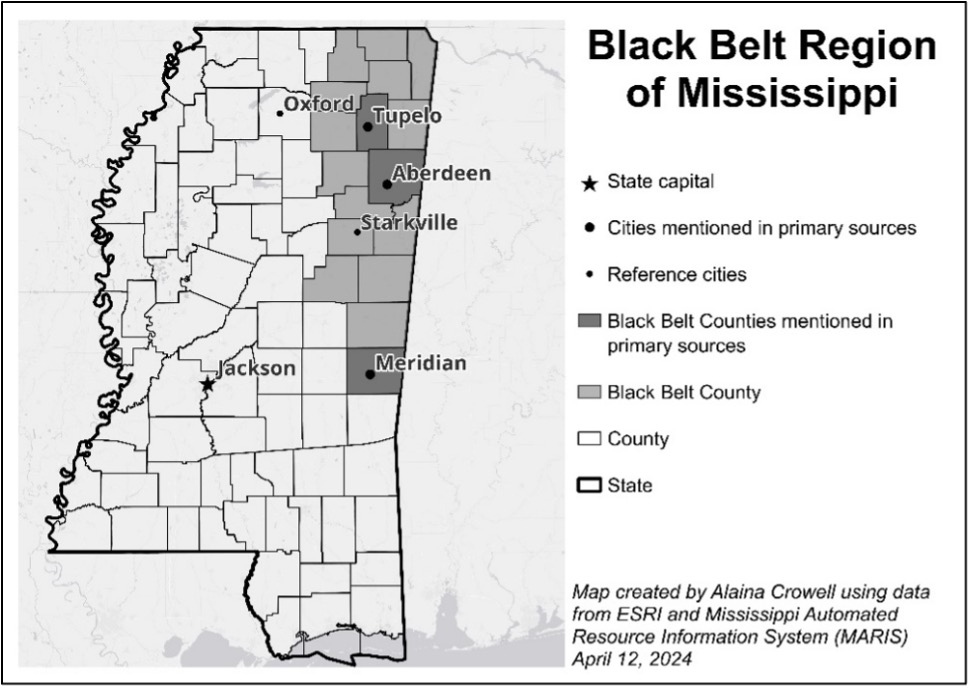
Evidence of local White obstruction is abundant in the Black Belt region of Mississippi, an area marked by large Black majorities in population, fertile prairies, and shared societal structures.5In 1935, W. E. B. Du Bois, a Black civil rights activist, sociologist, historian, and socialist, described the Black Belt region as the cotton plantation-heavy counties in the northeast prairies of Mississippi where land ownership was dominated by White planters and ex-enslavers. Du Bois further characterized the White planters as “barons” prioritizing continued profits over government compliance; most didn’t acknowledge the Confederacy’s loss in the Civil War, and White planters with local government positions or connections refused to grant Black citizens newly protected civil rights6 Du Bois’ work on Reconstruction served as an early rebuttal of the Lost Cause and the associated Dunning School mentioned earlier.
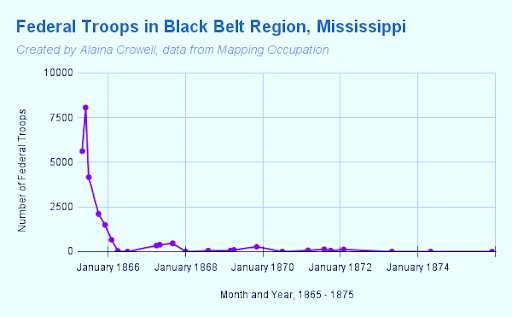
Congressional Republicans were optimistic that federal oversight of ex-Confederate states through provisional governments would prevent violent and harsh resistance from White communities in denial over the Confederacy’s disintegration, especially considering the continued presence of federal troops such as regiments of the U.S. Colored Troops (USCT). Serving as a general policing force, USCT and other regiments of federal troops were sparingly present in the Black Belt region in Mississippi after 1866 until the end of Reconstruction.7 However, the lack of troops wasn’t solely to blame for the harsh violence targeting Black communities across Mississippi; purely analytical approaches focused on military and political factors fail to capture the propensity of local governments in Black Belt counties to willingly obstruct federal and state law and oversight to protect White economic and social interests following the abolition of slavery.
In the Black Belt counties of eastern Mississippi in the Reconstruction Era, various White majority groups incited violence for reasons beyond political dissent. The presence of Northern teachers added to pre-existing tension between White ex-enslavers and Black communities, and provisional state governments failed to guarantee majority-White local governments would protect and enforce expanded civil rights for Black citizens. Exploring the experiences and writings of predominantly White groups such as free school teachers, postmasters, and Klansmen, reveals that White local governments in Black Belt counties functioned as an additional arm of the Klan. In an attempt to keep White citizens at the top of the Black Belt region’s power structure, White local governments ignored Black civil rights and destroyed Black communities, effectively obstructing civil rights gained through state and federal government legislation in the Reconstruction Era. Letters housed in the Civil War and Reconstruction Governors of Mississippi (CWRGM) database, congressional Ku Klux Klan (Klan, KKK) testimonies from 1872, a free school teacher’s memoir, and a congressional report on Mississippi election violence from 1875 (Senate Report of the Elections of 1875) all showcase the regionally-evident lapse of justice.
Obstruction in this region of Mississippi mid-Reconstruction is important to research both for what it reveals about local racial tensions and what it contributes to the historiography of Reconstruction. The Black Belt region of Mississippi is where cotton was “king;” cotton plantations in the Black Belt region were owned by wealthy Whites with established political power. Both their economic capital gained through their profitable plantations and social capital gained through White supremacist beliefs enabled White plantation owners to ignore federal protections of Black civil rights and willfully neglect to prosecute injustices against Black communities.8 The historical implication is that despite expanded federal protections, Black Mississippians in this region experienced no actual growth in their political protections during or after Reconstruction until the Civil Rights Movement in the 1950s and 1960s. A localized case study of this region then also becomes an act of recovering the realities of life in southern Black communities in regions where White supremacist violence was common. Previous historians fail to sufficiently capture that if White local governments and communities didn’t believe in racial equality, they had the existing economic, political, and social power to ignore it and openly destroy Black communities and their civil rights. White local governments effectively usurped the Supremacy Clause of the U.S. Constitution, which establishes the power of the federal government as supreme over the states, through collaborative obstruction, and this defiance continually prevented racial equality from being enshrined in American society and law until the Civil Rights Movement.
“Yankee Schoolmarms” and the Black Belt Klan
As the Civil War drew to a close in early 1865, the question that was faced by nearly all levels of the U.S. government was how to support the newly freed Black population across the nation. One answer was the creation of the Bureau of Refugees, Freedmen, and Abandoned Lands (Freedmen’s Bureau) in March 1865. Renowned Reconstruction historian Eric Foner explored the intentions and responsibilities of the Bureau’s establishment in his seminal work Reconstruction: America’s Unfinished Founding 1863-1877. To support Black communities, the Freedmen’s Bureau supplied food and clothing to Black citizens in need as well as federal oversight of Black populations’ “conditions” in ex-Confederate states. Foner asserts the scope of the Bureau, then, stretched across all aspects of economic, social, and political engagement.9 More recently than Foner, historian William A. Blair explored how Bureau agents also recorded violence against Black citizens in his book The Record of Murders and Outrages: Racial Violence and the Fight over Truth at the Dawn of Reconstruction. Bureau agents across the ex-Confederate South recorded instances of racial violence to demonstrate to federal and state elected officials that Black citizens were the primary target of White paramilitary groups. Federal and state politicians dismissed testimony from Black citizens proving White supremacists and Klansmen controlled local governments.10 Blair argues White supremacy in ex-Confederate states overthrew civil rights legislation during Reconstruction, similar to Willliams, but misses that the Bureau agents recording the outrages themselves were incomplete in their documentation as employees of a federal organization. Additionally, the Bureau itself only lasted until 1872, so organization records capture only a fraction of the murders and outrages targeting Black citizens. The Bureau’s leaders and most agents sought to aid Black citizens across Southern communities in various ways, but both Black citizens’ desires for self-determination (particularly in education) and White supremacists’ resistance to Reconstruction shrunk the Bureau’s sphere of influence.
The first (and only) leader of the Freedmen’s Bureau, General Oliver Otis Howard, saw education as the most important sort of aid the Bureau should offer to the free Black population. In a letter to all his assistant commissioners of the Bureau, Howard states how “virtuous intelligence and industry assure the stability and prosperity of a people.” While Howard doesn’t specify the importance of education for free Black populations, he suggests their inclusion in educational investments across ex-Confederate states like Mississippi would only bolster said prosperity, so long as there was “good faith on all hands in accepting these changes” practiced by communities promoting “simple justice.”11 Foner notes that because the Bureau didn’t have much funding or resources to support proposed free schools directly, Howard and his assistant commissioners had to collaborate with Northern aid societies to build and staff new free schools. These Northern aid societies were typically religiously affiliated, like the American Missionary Association (AMA), and they often sent Northern middle-class White women with some form of higher education experience.12
Black communities in the Black Belt region did not explicitly invite the Bureau and Northern aid societies’ support in the creation of free schools. Christopher M. Span, a professor of educational policy, claims in his book From Cottonfield to Schoolhouse that free Black citizens of northeast Mississippi were, as a group, uninterested in “uplifting” narratives delivered to them in schools by teachers from the North. Free Black communities in this region charged their own school tuition and fundraised to operate their community schools, and many did not report to Freedmen’s Bureau agents out of a fear of being stripped of authority over their own schools.13 Teachers sent by Northern aid societies were not guaranteed to shed their own racist beliefs that shaped the content and manner of instruction, and schools staffed by local White citizens were more likely to be shielded from instructional criticism due to local connections with White societies operating free schools. And, while Christianity was embraced by most Black and White communities in Black Belt counties, religiously-motivated instruction by White educators was more likely to encourage obedience to local laws, temperance, and other social attitudes that reflected a White desire for social control rather than the inherent value of equality and citizenship for Black communities in Mississippi society and culture.14 An example Span presents is how the literature used in Mississippi free schools by White teachers, beyond the Bible, sometimes included pro-slavery pamphlets that circulated before the close of the Civil War.15
Between the lack of committed federal funding, Black communities’ mistrust of government-supported free schools, and the lack of standardized teaching practices by free school teachers, it is clear how free schools failed to serve Black communities in Mississippi and across the South. While the disorganization of free schools is important to approach from the federal perspective Foner explores, a localized approach further reveals how actors at the state and local levels prevented Black citizens in Black Belt counties from securing their full civil rights. Literature produced by White free school teachers sheds light on the violence experienced by Black students and teachers and connects the failures of free schools directly to attacks by members of the White supremacist paramilitary group, the Ku Klux Klan (KKK).
Some of the most complete records documenting Northern free school teachers’ activities once they arrived in Southern states were women’s diaries and memoirs. Maria Waterbury, a free school teacher who taught temporarily in the Black Belt region, published a memoir of her experiences a little more than two decades after her free school teaching experience. Waterbury opens by recounting the call from Northern missionary societies to “go south about eight hundred miles, until you find the plantation school waiting for you.”16 When she arrived in Mississippi, Waterbury and her travelling partner, also a free school teacher, asked two sisters living near their assigned free school to stay the night before they found more permanent housing. One sister remarked she’d “beg … bread from door to door” before teaching Black students and declined housing the teachers as it would be a “disgrace.”17 Waterbury and her partner were then housed on plantation grounds in a large building previously used as a White boy’s school prior to the Civil War. The plantation grounds also had a store, a few shops, and a segregated school currently in use exclusively by the White community, as well as the “Sunday-school” where Waterbury and her partner were assigned to teach.18 Before the school opened, an integrated sermon was held at the Sunday school where Waterbury and her teaching partner met members of the Black community they’d be teaching; but, the free school didn’t open following this meeting. The White man who owned the land the school was set on, which Waterbury refers to as “the planter,” said the school would likely be burnt and delayed the opening of the school for several months.19
There is no record of Waterbury’s school being burnt, so this instance is more telling of the difference in violence faced between White free school teachers and Black citizens both resisting the Klan. Sandra E. Smalls in an article for the Journal of Southern History from 1979 mentions Waterbury’s memoir, more specifically the references Waterbury makes to threats such as this. Smalls examines patterns of attitudes across memoirs and diaries from twelve Northern women teaching at free schools across the South but deems Waterbury’s memoir too scattered to be considered a strong source for her article.20 Her article argues Northern free school teachers were the “primary targets” of an angry Southern White society, not free Black citizens, and aims to counter early narratives of “schoolmarms” as staunch advocates for Black equality by framing teachers’ approach to education through “wartime sacrifice and chauvinism.”21 Foner might agree that Northern teachers weren’t bastions of racial equality and progress, but Smalls is wrong to claim that Northern teachers received the harshest threats or attacks from White society and Klansmen. The U.S. Senate’s Report of Joint Select Committee to Inquire into the Condition of Affairs in the Late Insurrectionary States (Klan Report of 1872) was a congressional investigation of the Ku Klux Klan and other insurrectionary movements in the confederate states. Smalls returns to this report throughout her article, which details how Northern free school teachers were threatened or beaten prior to larger violent attacks carried out against entire Black communities across counties in Mississippi’s Black Belt region. Waterbury’s memoir thus becomes a good example of how threats against Northern free school teachers paled in comparison to violence faced by Black citizens.
Waterbury copied a picture of a threat she and a fellow teacher received while teaching at a free school from local Klansmen: it is a black and white sketch of a White woman tied to a tree, whose expression is drawn like a damsel in distress, with a White man at each side. One is holding a whip and rolling up his sleeve, while the other is already in motion to whip the woman. The caption Waterbury attached is a copied letter that accompanied the picture when the women received it. The letter read: “We send you a picture of the way we treated a Yankee school ma’am in this county last year. Beware lest you shear [sic] the same fate. Regulaters [sic].”22 The school didn’t close after receiving this threat and supposedly ran through the end of its term. Examples like this were more common for White female teachers than White male teachers and Black citizens, since the latter two groups received not only threats, but also faced violent attacks, likely due to a racialized and gendered perception of White women as delicate, as misguided rather than enemies. The difference is sharp when Waterbury mentions “Uncle Billy,” an older Black man she taught while in Monroe County, Mississippi, who asked to take home readings from the school for his son to teach him. He tells Waterbury the only time he engaged with reading was when his previous enslaver would read passages of the Bible to him, though the passages were intended by the enslaver to promote obedience and unwavering loyalty to the enslaver and slavery itself. Uncle Billy also tells Waterbury multiple times: “Ef ye only knowed how we is sufferin’ tu larn [sic].”23 According to Waterbury’s account, shortly after Uncle Billy spoke with her, a KKK raid swept through the town she was teaching in, likely Aberdeen. Uncle Billy and several of the school’s students were killed, “whose only crime was that they were learning fast, and could vote intelligently.”24
Testimonies throughout the Klan Report of 1872 demonstrate the difference of lived and perceived violence faced by White female teachers in contrast to Black Mississippians. Elected officials on the committee interviewed many White Mississippians across the Black Belt region to better understand why frequent and violent lynchings of Black Mississippians were rarely prosecuted in the region. They asked questions regarding violence against teachers and free schools to grasp how communities dealt with such destructive and unchecked violence. Rufus B. Stone, an Aberdeen resident and federal employee, testified in the fall of 1871 that he knew of many lynchings of Black men in the region who were last seen being taken by masked, cloaked, or disguised men. Committee members asked Stone if he could name the masked men and Stone failed. When asked to identify teachers who were threatened, Stone didn’t hesitate to name individuals.25 It is unclear if Stone truly never knew who the Klansmen were or if he felt safer sharing information about teachers since they were less charged examples of local government negligence. Testifying that teachers were threatened but withholding the mention of violence targeting Black citizens is a type of private obstruction exercised by many White citizens like Stone that veil the historical record. Historians reading the Klan Report for the first time didn’t characterize the larger scope of violence because private obstruction by community members testifying in federal Klan reports didn’t record it. Building on Blair, these gaps in government records suggest that officials who sympathized with or were private members of the Klan obstructed the complete scope of violence in Black Belt counties by “[dismissing] the murders, rapes, assaults, and other outrages on Black people as either cultural or social conflicts rather than struggles over political power to maintain white supremacy.”26 This is a pattern in the Klan Report, at least regarding violence in the Black Belt region: the committee devotes much more attention to threats against teachers and the local government’s failure to punish Klansmen for violent acts while only asking surface-level questions regarding the lynchings of at least a dozen Black Mississippians. Violence faced directly by Black Mississippians are opening facts but not clearly the driving factor in holding the hearings, and examining the report retrospectively with this built-in bias in mind further reveals how deep the commitment for obstruction ran among many White communities in the Black Belt region.
Tupelo’s Anna Davis and the Klan
One person mentioned in the Klan Report was situated at such an intersection of roles that her story offers greater insights into how Northern teachers contributed to community tensions in Lee County specifically. Anna Davis was a Northern White free school teacher who served as postmaster of Tupelo from September 1869 until at least November 1871.27 The free school she taught at operated out of the local African Methodist Episcopal Church, which she helped build.28 Davis’s post office was run from the corner of a general store at the town center, which was commonplace for post offices of the 19th century.29 Most kept an inventory of all mail on hand usually with the help of an appointed assistant, and were expected to sort, collect, and sell postage seven days a week. Their salary, depending on the postage they sold each financial quarter, could range from under $50 to nearly $4,000. Considered to hold a position of authority over their communities, postmasters were often asked by state and national officials to provide written testimony of a person’s character.30 Davis thus held a position of prestige that placed her at the center of her community.
Because postmasters were government-appointed officials, their appointment ebbed with party politics of their time.31 Davis, then, was likely appointed by President Ulysses Grant’s Postmaster-General, John Creswell, because of her residence in Tupelo as a free school teacher and her support for the Black community as it aligned with Reconstruction. Historian Cameron Blevins observes how post office positions offered women a path to participate in the inner workings of local governments, or at least have some control over the community’s flow of information.32 As a postmaster and teacher, Davis had the power to oversee communication between Tupelo residents and the rest of the nation as well as the language she would use to instruct Black students at school. Even though postmasters like Davis were uniquely privy to the intricate communication networks of their communities, they were largely unsuccessful in restricting threatening mail sent by White citizens involved with paramilitary organizations like the Klan due to their use of vaguely religious language.
The free school Davis taught at was burnt down in September 1871 by an older White man named Freeman. Before burning the school, he kidnapped and raped one of Davis’s Black students, threatened Davis at her home, and condemned the erection of the “radical church.”33 Members of the Klan, who lynched Black citizens of Tupelo around the same time as the church was burnt, also threatened Davis at her post office and warned her not to deliver mail.34 The failure of Davis, who clearly supported Black citizens and opposed the Klan, to prevent violent uprisings, shows the limitations of federally-appointed positions to protect Black community members from threats, destruction, and lynchings.
A. Devi, a resident of Tupelo, wrote to Mississippi Governor James L. Alcorn shortly after the free school in Tupelo was burnt down. Devi stated the town was in a “reign of perfect terror” and requested Alcorn to solicit U.S. troops to put down the violence.35 Davis claimed she would not testify in subsequent trials brought against Freeman and the other assailants without the presence of the U.S. army to protect her and other witnesses. Her reluctance was surely tied to her role as a woman appointed to political, educational, and religious leadership positions supporting emancipation and equal education in an overwhelmingly patriarchal Southern society previously dominated by White male Democrats.36 Reuben O. Reynolds, who testified for the Senate’s Klan Report in November 1871, seemed to loathe Davis and other teachers’ presence, claiming they “sought to inculcate doctrines into the minds of their pupils which many of us [White men] think are likely to produce discord and dissension.”37 Rufus B. Stone, who testified on the same day, described Davis as “the support of the Republican party in [Lee County] – the nucleus around which [Black citizens] gather.”38
Despite being loathed by many local Whites as an appointed federal employee in a local office as well as a free school teacher, Davis was fortunately spared her life, unlike the numerous Black Mississippians named in the Klan Report. Her identity as a White woman in the Black Belt protected her from the harshest forms of violence practiced by the Klan even though she was regarded as a leader for the Republican and Black communities in Lee County.
And, while nothing in the Klan Report suggests that Freeman was a member of the Klan, his lawyer, Samuel J. Gholson, was well understood to be the leader of the Klan in Monroe County, which borders Lee County (where Tupelo is) to the southeast.39 Gholson previously served as a state legislator, U.S. Representative, and U.S. District Court judge all within Mississippi. He supported the state’s secession as a member of the secession committee, and during the Civil War, he served as a Confederate soldier, later becoming Major-General of Mississippi State Troops. When the Civil War ended, he resumed his practice in law and often defended Klansmen in federal courts.40 His previous experience as a federal judge, compounded with the fact that he was still well-respected by White Mississippians across the Black Belt counties, likely contributed to the low conviction rate of the Klansmen he represented, regardless of the facts of their cases. Gholson testified in the Klan Report on Freeman’s case and knew of the lynching of Doc Hendrickson, a Black man, around the same time as the burning of the free school in Tupelo. However, he claimed to know nothing about the lynching of Tobe Hutchinson of Lee County, also a Black man, because Gholson was in court on other duties that week.41
The destruction of Davis’s school was not an isolated event; school burnings were one of the more visible forms of violence and destruction targeting Black communities and White allies in the Black Belt counties, and the consequence in contemporary times is that there are little remaining physical signs of schools or arson on the Black Belt landscape. Campbell F. Scribner, a professor of education at the University of Maryland, published an article in the Journal of the Civil War Era analyzing the destruction of 631 free Black schoolhouses throughout the Reconstruction South.42 Scribner reports 158 schools destroyed in Mississippi, which, out of the total 631 he records, accounts for 25 percent of schools burned.43 Scribner acknowledges the inherent gaps in newspaper articles, Congressional testimonies, and Freedmen’s Bureau records as reflective of the prejudice of Bureau agents who collected them, and also rightly notes how local obstruction and the “politicization of school destruction” contributed to underreporting of school burnings.44 The destruction of Davis’s Tupelo free school and the history between Davis and Freeman expands on Scribner by demonstrating how many White citizens of Black Belt regions obstructed civil rights legislation and justice for Black citizens and White allies in Black Belt counties.
Gholson’s record of turning a blind eye to violence against Black citizens was not unique and historians have grappled with this issue over time. Scribner ascribed the failure of local governments to punish Klan arsonists to politicization since accusing the Klan of violent crimes “segregated them from mainstream politics [and asserted] that anyone who burned a school [was not] Southern society writ large.”45
Far from just the political factors identified by Scribner, the failure to protect Black Mississippians in the Black Belt from Klan violence resulted from a mix of poor legislative design of the Enforcement Act and the inability of local governments to recognize Black citizens’ full protections under federal law. The Enforcement Act of 1870 was signed into law by President Grant in May but couldn’t be enforced until 1871. It allowed for the president to send federal troops to states where election violence was imminent or regularly occurring and affirmed federal courts had the jurisdiction to prosecute crimes under the act. The Enforcement Act of 1870 is most often remembered for a section which criminalizes terror, force, or bribery at state and federal elections, but Gholson’s appointment violated a section of the Enforcement Act that criminalizes any citizen known to be obstructing the execution of arrests under the Enforcement Act.46 As a known Klan leader, Gholson could have been arrested for his conflict of interest as a Klan member protecting other Klan members from convictions under the act. Because the Enforcement Act was not applied by local governments due to the Klan’s control, Black citizens and teachers were not fully protected from Klan violence, and their civil rights weren’t recognized.
Local Obstruction in Meridian and Aberdeen
The obstruction and corruption easily gave way to violence against Black citizens, their schools, White teachers, and Republicans in the local governments of the Black Belt. Violent events occurred with similar outcomes: Klansmen attacked Black communities and their allies and faced little to no punishment by state and federal courts. If White figures of authority did not have the motivation, receive public pressure from White citizens, or get direction from state or federal officials, justice would not be sought for destruction that targeted Black communities in the Black Belt counties. And, if White legislators were sympathetic to (or members of) the Klan, obstruction of justice for crimes against Black citizens were nearly guaranteed to repeatedly occur with no consequences for the White agitators.47 Two examples occurring within the Black Belt region speak to this pattern of obstruction and raise further questions about the actual impact of the Enforcement Act: the Meridian Race Riot of 1871 and the broad election violence targeting Black citizens of Aberdeen.
Historian Allen W. Trelease was the first to research the widespread violence brought on by the Klan across the ex-Confederate states in his 1971 book White Terror: The Ku Klux Klan Conspiracy and Southern Reconstruction. Like this case study, he uses the Klan Report alongside newspaper articles and local histories on counties during Reconstruction to uncover the overlap between local governments and Klan violence. Trelease describes the Meridian Race Riot of 1871 as a “riot,” but in doing so, he fails to accurately capture the manner in which the violence unfolded. By framing the Meridian Race Riot as a “riot,” he misrepresented the violent environment that Black citizens experienced in Meridian as temporary rather than a persistent reality created by White supremacist local government officials and community members. It would therefore be more accurate to characterize the so-called Meridian Race Riot as a massacre, rather than a riot because of the large number of Black citizens murdered by members of White supremacist mobs, although it will continue to be referred to as the Meridian Race Riot within this paper for the sake of clarity within the wider historical record.
In March, a mob of White Klansmen from both Mississippi and Alabama murdered at least 30 Black citizens over a span of three days. The event began with an altercation between Daniel Price, a White free school teacher previously from Alabama, and Alabamian deputy sheriff Adam Kennard, although sources differ on which party was the instigator. Historians disagree on Kennard’s race and occupation, with some describing him as a White bounty hunter, and others describing him as being Black, a deputized Freedman who may have aligned himself with Democrats for his personal and familial protection from racial violence.48 Following Kennard’s initial attack, Price and a group of Black citizens from Meridian approached Kennard to retaliate and show their resistance to violence against free schools and their supporters. Kennard’s connections to White members of Meridian’s local government shielded Kennard from punishment and instead Price was charged under the Enforcement Act for attacking Kennard while masked.49 Price’s hearing was repeatedly postponed by the town’s mayor, Northerner William Sturgis, due to his fear of a potential massacre against the Black citizens in Meridian, and Price later fled at Sturgis’s suggestion.50 A month prior to Kennard’s attack, a citizen wrote Mississippi’s governor, James Alcorn, that Sturgis should be appointed Meridian’s sheriff, as “his appointment…would secure the execution of the laws, regard-less of any consequences, affect-ing private interests.” This citizen claimed: “[Sturgis] has in every difficulty, where others ‘flinched’… not hesitated to bring about peace.”51 Trelease’s White Terror further supports this citizen’s claims to Sturgis’s reputation as a Republican enforcer. Sturgis petitioned Alcorn to send soldiers to protect Black citizens from further harm, but they occupied Meridian for less than a week. Meridian’s Democrats wrote Alcorn to remove Sturgis from his mayorship, and even some local Republicans wanted him to resign “for the sake of harmony” (of the White population). Sturgis responded by sending local Black leaders to Alcorn at the state capitol to persuade him to secure better protection of the Black community’s safety.52
Black citizens of Meridian organized against Kennard in strong numbers, demonstrating the community’s need to protect themselves if the mayor and state would not. Aaron Moore, a local Black preacher and legislator, organized a group of armed Black citizens to resist the repeated violence. Warren Tyler and William Dennis were other key leaders of these self-defense efforts. The Black community marched the streets of Meridian to protest the patterns of violence and obstruction plaguing their community. Threatened by the show of Black strength and agency, local Klansmen jailed Moore, Tyler, and Dennis overnight for “incendiary speech.” The White community met the following day to oust the mayor, since he was understood to be the last Black ally in Meridian local government, and the next day, a hearing was held for Moore, Dennis, and Tyler. It wasn’t postponed the same way that Price’s was and Sturgis’s fears actualized: the judge was shot by a man in the crowd and the massacre began. Moore managed to escape, but Tyler and Dennis were among the 30 Black citizens killed by the Klansmen. The Klan also burned a local church where Black citizens organized resistance efforts. Six Klansmen were arrested for the murder and destruction, but all were acquitted by a local jury of White citizens.53
The Meridian Race Riot of 1871 followed several patterns of violence common to the Black Belt region of Mississippi. A White free school teacher, in this instance Price, was attacked by interstate Klansmen for his support for the education of Black citizens. Kennard and his group could have been arrested for attacking Price, especially considering Kennard was the known perpetrator and out of his jurisdiction as a local Alabama sheriff. Instead, Price and a group of Black citizens were arrested under the Enforcement Act for retaliating due to the Democratic White community’s desire for White prosperity. The unequal application of the law demonstrates foul play by the local government. It is likely that Kennard’s allegations against Price and the Black citizens who assisted in the attack carried more weight in Meridian’s government simply because they were Republicans supporting or a part of the Black community. Three months after the massacre, a White lawyer testified in a federal investigation that there was no Klan in Meridian or Mississippi, and that the murders were merely the result of “bad teachings by bad men of both parties, who wanted strife.” He instead highlighted the attack on Kennard while neglecting to mention the violence Kennard instigated against Price for simply teaching and supporting the Black community.54
A few counties north of Meridian, Black citizens and their civil rights were further obstructed through disenfranchisement at local, state, and federal elections in 1875. The Klan in Monroe County, as well as the wider Klan presence across the post-war South, prevented Black citizens from voting freely by threatening or lynching Black citizens and destroying their communities. Black disenfranchisement by the Klan is widely known, but examining election violence at a local level reveals how local White citizens contributed to obstruction of civil rights of Black citizens by not enforcing federal protections.
James W. Lee, the sheriff of Aberdeen, wrote a letter to Governor Adelbert Ames in late October of 1875 that local White Democrats were creating an “awful condition” in the town. He reported that Democrats stormed a Republican meeting, destroyed their drums, and attacked several Black men. Lee also claimed the Democrats beat and shot at Black citizens openly in the town, calling them “exceedingly aggressive” about fixing the upcoming election for a Democratic victory by force. He started his letter alerting Ames that the Democrats had a cannon in their arsenal.55 The same day Lee wrote this first letter, James Z. George, the leader of the state Democratic Party, received communication from Democrats near Monroe County that a “radical sheriff” wrote to the governor to tell of the intimidation efforts of local Democrats. They requested that if George, who was then at the state capital, could reach Ames then he should ask him to “do nothing” until they could “send a full statement.”56 George was more than the Democratic Party leader. Though he served that role since the beginning of 1875, he served as a Confederate general during the Civil War. Following the conflict, like Samuel J. Gholson, he practiced law. George moved his family to the state capital, Jackson, in 1873 and eventually led Democrats and Klansmen across the state in the quest to reinstate the rule of White supremacy in Mississippi.57
Sheriff Lee and George sent letters and communications back and forth with Governor Ames in attempts to direct his support towards their respective beliefs: Lee wanted Ames to send troops to defend Black and Republican citizens in Aberdeen so they wouldn’t be disenfranchised, and George wanted Ames to think Democrats were merely campaigning like the Republican party was. Lee sent a slew of letters to Ames from the end of October 1875 to February 1876 presenting evidence of Democratic intimidation, spearheaded by George’s leadership in Jackson. Lee wrote that Democrats “would have 1,500 men from Alabama…compel the [Black men] to vote the Democratic ticket or not vote at all.”58 Lee then claimed there were at least 50 more witnesses to the Black disenfranchisement and election intimidation that he could have written to Ames, that the Black community was working to send representatives to Ames to demand troops for their protection, and that the “Democrats will swear to any statement in order to carry their point.”59 George didn’t have to do much to counter Lee’s evidence from his position as leader of the Democratic Party and his prominence within the state’s legal community; George wrote to Thomas B. Sykes, a judge on the state Supreme Court, and Reuben O. Reynolds, a known Democrat of Monroe County, about Lee’s letter to Ames regarding the election violence in Aberdeen.60
Sheriff Lee followed up with Governor Ames after the election concluded, detailing the full extent of Black and Republican disenfranchisement in Monroe County. He reported “all the fords on the [Tombigbee] river were guarded by [Klansmen] who drove every man back unless he was going to vote the democratic ticket.” Lee claimed that even the “U.S. Supervisor of election kept away from the election in Aberdeen through actual fear of being killed if he went.”61 The intimidation of Black and Republican voters by Democrats and Klansmen was so intense that even the federally appointed election supervisor was unable to ensure a free and fair election.
The White citizens of the Black Belt counties were so overwhelmingly determined to preserve their power and prosperity that members and sympathizers of the Klan could ignore the supremacy of federal law to determine local and state elections.Although states generally have power over their own elections, the 15th Amendment supposedly protected the voting rights of Black citizens, but was routinely ignored by White lawmakers, especially Klan members and sympathizers. Governor Ames partially allowed for this, seeing as Sheriff Lee and the proposed delegation of Black citizens repeatedly asked for troops to protect voters and the Governor failed to send any. After claiming victory in the 1875 elections, James Z. George ascended the political scene and became a U.S. Senator in 1881.62 During his time in office, he attended Mississippi’s 1890 Constitutional Convention, where he voted to disenfranchise Black citizens in the new state constitution by installing literacy tests and poll taxes.63 George’s ascension came after the U.S. Senate Report of the Elections of 1875. So, even though the committee understood Mississippi’s elections in 1875 were “characterized by great frauds” perpetrated by the Democratic Party, Democrat-controlled Mississippi resulted from the widespread disenfranchisement of Black and Republican voters, and the 15th Amendment passed to protect Black men’s enfranchisement, White citizens of Black Belt counties repeatedly chose to support White supremacist legislators.64
Conclusion
A close examination of intimate community dynamics of Black and White communities in Black Belt counties in Mississippi from 1865 to 1875 demonstrates how most White citizens from inside and outside local government positions enabled obstruction and violence targeting Black citizens. The experiences and writings of predominantly White groups such as free school teachers, postmasters, and Klansmen reveals how White local governments in three particular Black Belt counties functioned as an extension of the Klan, or that the local government and the Klan were functionally the same organization; evidence also suggests many counties in the region and state likely functioned similarly because of purposeful disregard for federal laws and connections between Klansmen and powerful ex-Confederate politicians and White community leaders.
Despite these many examples of local obstruction, the issue has escaped documentation and examination in the historical record because of both unintentional and intentional erasure and destruction of Black communities’ infrastructure, civil rights protections, and livelihoods. In an article regarding the construction of the War of the Rebellion collection from 1866, historian Yael A. Sternhell sheds light on the problems of historic erasure and the Black experience in Reconstruction.65 The War of the Rebellion collection was a federal attempt at documenting the history of the Civil War through surviving Union and Confederate documents, and observations Sternhell makes about the creation of the federally-managed archives and printable collections are also applicable to the historic record of Black Belt counties of Mississippi. Sternhell notes that countless documents are missing from government-commissioned narratives of the Civil War due to the initial destruction or loss of Confederate records immediately following the close of the war.66 Sternhell comments that the War of the Rebellion compilation “enabled the comforting, reunionist histories that marginalized the importance of emancipation and generally ignored the role of African Americans” by giving both sides an equal voice and focusing the war on battlefield drama rather than slavery and civil rights.67 Omission or destruction of evidence to this scale is not rare, as many records from Black Southerners were either unintentionally lost, destroyed, or deemed dispensable to the historical record. Localized case studies on areas with historically Black majority populations help bridge this scholarship gap by illuminating Black perspectives through communication channels which functionally ignored the weight of Black voices. Sternhell’s claims that White desires for reconciliation and the suppression of Black civil rights were anything but mutually exclusive supports the conclusions of this paper. Local governments across the ex-Confederate South, and especially those within the Black Belt region of northeastern Mississippi, willingly defied the supremacy of the federal government by restricting or denying Black citizens’ civil rights. These local governments aimed to reinstate White supremacist leadership, reconcile with the federal government in writing, and continue to elect and support Southern White politicians who were sympathetic to or were members of the Klan to preserve or restore white supremacist leadership in local governments.
Because of White obstruction and destruction of Black communities in the Black Belt region, there is little physical evidence of the atrocities to remind Black Belt citizens today of the region’s particularly disturbing past. This is a consequence of continued negligence by White local governments who didn’t care to protect Black civil rights out of shared community beliefs in White supremacy. Researching this region now contributes to the growing bodies of scholarship demanding fuller considerations of community cultures that explain why Black histories are still understudied. More concise studies on the destruction of free schools, like Scribner’s project, would further repair the holes in the historic record, or at least force historians to reckon with the legacy of White supremacy and its supporters’ desires to obstruct and destroy Black civil rights.
Bibliography
Secondary Sources
Blair, William A. The Record of Murders and Outrages: Racial Violence and the Fight over Truth at the Dawn of Reconstruction. Chapel Hill, NC: University of North Carolina Press, 2021.https://www.jstor.org/stable/10.5149/9781469663470_blair.
Blevins, Cameron. “Women and Federal Officeholding in the Late Nineteenth-Century U.S.” Current Research in Digital History 2 (August 2019). https://doi.org/10.31835/crdh.2019.08.
Du Bois, W. E. B. Black Reconstruction in America: An Essay Toward a History of the Part Which Black Folk Played in the Attempt to Reconstruct Democracy in America, 1860–1880. New York: Harcourt, Brace and Company, Inc., 1935, https://cominsitu.wordpress.com/wp-content/uploads/2019/02/w-e-b-du-bois-black-reconstruction-an-essay-toward-a-history-of-the-part-which-black-folk-played-in-the-attempt-to-reconstruct-democracy-2.pdf.
Foner, Eric. Reconstruction: America’s Unfinished Revolution 1863-1877. New York: Harper & Row, 1988. https://libcom.org/article/reconstruction-americas-unfinished-revolution-1863-1877-eric-foner.
MacGown, Joe, Richard Brown, and JoVonn Hill. “The Black Belt Prairie in Mississippi and Alabama.” Mississippi Entomological Museum, January 21, 2022. https://www.mississippientomologicalmuseum.org.msstate.edu/habitats/black.belt.prairie/BlackBeltPrairie.htm#.WyqaQC2ZNE5.
Newton, Michael. The Ku Klux Klan in Mississippi: A History. Jefferson, North Carolina: McFarland & Company, 2009.
Prechtel‐Kluskens, Claire. “National Archives: The Nineteenth‐Century Postmaster and His Duties.” National Genealogical Society Magazine, January 1, 2007.
Scribner, Campbell F. “Surveying the Destruction of African American Schoolhouses in the South, 1864-1876.” Journal of the Civil War Era 10, no. 4 (December 2020): 469-494. https://www.jstor.org/stable/26977402.
Smalls, Sandra E. “The Yankee Schoolmarm in Freedmen’s Schools: An Analysis of Attitudes.” Journal of Southern History 45, no. 3 (August 1979): 381-402. https://doi.org/10.2307/2208200.
Smith, Timothy B. James Z. George: Mississippi’s Great Commoner. Oxford, MS: University Press of Mississippi, 2012. ProQuest.
Span, Christopher M. From Cottonfield to Schoolhouse: African American Education in Mississippi, 1862-1875. Chapel Hill, NC: University of North Carolina Press, 2009. ProQuest.
Sternhell, Yael A. “The Afterlives of a Confederate Archive: Civil War Documents and the Making of Sectional Reconciliation.” Journal of American History 102, no. 4 (March 2016): 1025-1050. https://doi.org/10.1093/jahist/jav747.
Trelease, Allen W. White Terror: The Ku Klux Klan Conspiracy and Southern Reconstruction. New York: Harper & Row, 1971.
Williams, Kidada E. I Saw Death Coming: A History of Terror and Survival in the War against Reconstruction. New York: Bloomsbury Publishing, 2023.
Primary Sources
Letter from J. P. Allen to Mississippi Governor James L. Alcorn; February 18, 1871. Alcorn Series 786: Box 972, Folder 7. Civil War and Reconstruction Governors of Mississippi Project (digital, hereafter CWRGM). Mississippi Department of Archives and History (Jackson, Miss., hereafter MDAH). Accessed March 30, 2024. https://cwrgm.org/item/mdah_786-972-07-01.
Letter from A. Devi to Mississippi Governor James L. Alcorn; September 29, 1871. Alcorn Series 786: Box 973, Folder 12. CWRGM (digital). MDAH (Jackson, Miss.). Accessed November 14, 2023. https://cwrgm.org/item/mdah_786-973-12-16.
Letter from J. W. Lee to Mississippi Governor Adelbert Ames; October 23, 1875. Ames Series 803: Box 997, Folder 11. CWRGM (digital). MDAH (Jackson, Miss.). Accessed March 30, 2024. https://cwrgm.org/item/mdah_803-997-11-19.
Letter from James W. Lee to Mississippi Governor Adelbert Ames; October 26, 1875. Ames Series 803: Box 997, Folder 12. CWRGM (digital). MDAH (Jackson, Miss.). Accessed March 30, 2024. https://cwrgm.org/item/mdah_803-997-12-07.
Letter from James W. Lee to Mississippi Governor Adelbert Ames; October 28, 1875. Ames Series 803: Box 997, Folder 13. CWRGM (digital). MDAH (Jackson, Miss.). Accessed March 30, 2024. https://cwrgm.org/item/mdah_803-997-13-09.
Letter from James W. Lee to Mississippi Governor Adelbert Ames; February 7, 1876. Ames Series 803: Box 999, Folder 4. CWRGM (digital). MDAH (Jackson, Miss.). Accessed March 30, 2024. https://cwrgm.org/item/mdah_803-999-04-09.
Lynch, James Daniel. The Bench and Bar of Mississippi. New York: E. J. Hale & Son, 1881. https://archive.org/details/cu31924018792899/mode/2up.
“The Mississippi Kuklux Question.” Richmond Daily Dispatch. June 30, 1871. Library of Congress.
Postmaster Appointments for Lee County, Mississippi; Records of Appointment of Postmasters and the Establishment of Post Offices, July 1, 1931–October 31, 1971; Record of Appointments of Postmasters, 1832–Sept. 30, 1971 (National Archives Microfilm Publication M841, roll 68); Records of the Post Office Department, 1773-1971, Record Group 28; National Archives Building, Washington, D.C.). https://catalog.archives.gov/id/78752217.
Printed letter from General O. O. Howard, June 14, 1865. Sharkey Series 771: Box 954, Folder 2. CWRGM (digital). MDAH (Jackson, Miss.). Accessed March 11, 2024. https://cwrgm.org/item/mdah_771-954-02-09.
US Congress, Joint Select Committee to Inquire into the Condition of Affairs in the Late Insurrectionary States. Testimony Taken by the Joint Select Committee to Inquire into the Condition of Affairs in the Late Insurrectionary States: Mississippi (Klan Report). Vol. 12. Government Printing Office, 1872. https://archive.org/details/reportofjointsel12unit/mode/2up.
US Congress, Senate. Report of the Select Committee to Inquire into the Mississippi Election of 1875 with the Testimony and Documentary Evidence (Senate Report of the Elections of 1875). Government Printing Office, 1876. https://archive.org/details/mississippiin18701unit/mode/1up.
Waterbury, Maria. Seven Years Among the Freedmen. 3rd ed. Chicago: T. B. Arnold, 1893.
Footnotes
- Kidada E. Williams, I Saw Death Coming: A History of Terror and Survival in the War against Reconstruction (New York: Bloomsbury Publishing, 2023), xix. ↩︎
- See William A. Dunning, Reconstruction, Political and Economic, 1865-1877 (New York: Harper & Brothers, 1907); Claude G. Bowers, The Tragic Era: The Revolution After Lincoln (Cambridge: Houghton Mifflin, 1929). ↩︎
- Eric Foner, Reconstruction: America’s Unfinished Revolution 1863-1877 (New York, New York: Harper & Row, 1988), https://libcom.org/article/reconstruction-americas-unfinished-revolution-1863-1877-eric-foner. ↩︎
- Williams, I Saw Death Coming, xxi. ↩︎
- Joe MacGown, Richard Brown, and JoVonn Hill, “The Black Belt Prairie in Mississippi and Alabama,” Mississippi Entomological Museum, January 21, 2022, https://www.mississippientomologicalmuseum.org.msstate.edu/habitats/black.belt.prairie/BlackBeltPrairie.htm#.WyqaQC2ZNE5. ↩︎
- W. E. B. Du Bois, Black Reconstruction in America: An Essay Toward a History of the Part Which Black Folk Played in the Attempt to Reconstruct Democracy in America, 1860–1880 (New York: Harcourt, Brace and Company, Inc., 1935), 431, https://cominsitu.files.wordpress.com/2019/02/w-e-b-du-bois-black-reconstruction-an-essay-toward-a-history-of-the-part-which-black-folk-played-in-the-attempt-to-reconstruct-democracy-2.pdf. ↩︎
- Chart data from Gregory P. Downs and Scott Nesbit, Mapping Occupation: Force, Freedom, and the Army in Reconstruction, http://mappingoccupation.org, published March 2015, accessed April 17, 2024. “Mapping Occupation” is a project in digital history mapping the count of federal troops across ex-Confederate states through primary sources from May 1865 to December 1880. See also Gregory P. Downs, After Appomattox: Military Occupation and the Ends of War (Cambridge, MA: Harvard University Press, 2019). ↩︎
- Du Bois, Black Reconstruction in America, 431. ↩︎
- Foner, Reconstruction, 110. ↩︎
- William A. Blair, The Record of Murders and Outrages: Racial Violence and the Fight over Truth at the Dawn of Reconstruction (Chapel Hill, NC: University of North Carolina Press, 2021), 2, https://www.jstor.org/stable/10.5149/9781469663470_blair. ↩︎
- Printed letter from General O. O. Howard, June 14, 1865, Sharkey Series 771: Box 954, Folder 2, Mississippi Department of Archives and History (Jackson, Miss., hereafter MDAH) accessed digitally through Civil War and Reconstruction Governors of Mississippi Project (digital, hereafter CWRGM), accessed March 11, 2024, https://cwrgm.org/item/mdah_771-954-02-09. ↩︎
- Foner, Reconstruction, 192. ↩︎
- Christopher M. Span, From Cottonfield to Schoolhouse: African American Education in Mississippi, 1862-1875 (Chapel Hill, NC: University of North Carolina Press, 2009), 40. ↩︎
- Foner, Reconstruction, 193-94. ↩︎
- Span, From Cottonfield to Schoolhouse, 35-36. ↩︎
- Maria Waterbury, Seven Years Among the Freedmen, 3rd ed. (Chicago: T. B. Arnold, 1893), 9, https://www.google.com/books/edition/Seven_Years_Among_the_Freedmen/IJsLAAAAIAAJ?hl=en&gbpv=1&dq=Maria+Waterbury,+Seven+Years+Among+the+Freedmen,+3rd+ed.&pg=PA3&printsec=frontcover. ↩︎
- Waterbury, Seven Years, 15. ↩︎
- Waterbury, Seven Years, 18. ↩︎
- Waterbury, Seven Years, 19. ↩︎
- Sandra E. Smalls, “The Yankee Schoolmarm in Freedmen’s Schools: An Analysis of Attitudes,” Journal of Southern History 45, no. 3 (August 1979): 384, https://doi.org/10.2307/2208200. ↩︎
- Smalls, “The Yankee Schoolmarm,” 383, 368. ↩︎
- Waterbury, Seven Years, 42. ↩︎
- Waterbury, Seven Years, 81. ↩︎
- Waterbury, Seven Years, 81-82. ↩︎
- US Congress, Joint Select Committee to Inquire into the Condition of Affairs in the Late Insurrectionary States, Testimony Taken by the Joint Select Committee to Inquire into the Condition of Affairs in the Late Insurrectionary States. Mississippi (hereafter Klan Report), vol. 12 (Washington: Government Printing Office, 1872), 823, https://archive.org/details/reportofjointsel12unit/mode/2up. ↩︎
- Blair, The Record of Murders and Outrages, 2. ↩︎
- Postmaster Appointments for Lee County, Mississippi; Records of Appointment of Postmasters and the Establishment of Post Offices, July 1, 1931–October 31, 1971; Record of Appointments of Postmasters, 1832–Sept. 30, 1971 (National Archives Microfilm Publication M841, roll 68); Records of the Post Office Department, 1773-1971, Record Group 28; National Archives Building, Washington, DC), https://catalog.archives.gov/id/78752217; US Congress, Klan Report, 870. ↩︎
- US Congress, Klan Report, 870. ↩︎
- US Congress, Klan Report, 823. ↩︎
- Claire Prechtel‐Kluskens, “National Archives: The Nineteenth‐Century Postmaster and His Duties,” National Genealogical Society Magazine, January 1, 2007. ↩︎
- Cameron Blevins, “Women and Federal Officeholding in the Late Nineteenth-Century U.S.,” Current Research in Digital History 2 (August 2019), https://doi.org/10.31835/crdh.2019.08. ↩︎
- Blevins, “Women and Federal Officeholding.” ↩︎
- Michael Newton, The Ku Klux Klan in Mississippi: A History (Jefferson, North Carolina: McFarland & Company, 2009): 21; US Congress Klan Report, 823; US Congress, Klan Report, 1166. ↩︎
- US Congress, Klan Report, 823. ↩︎
- Letter from A. Devi to Mississippi Governor James L. Alcorn; September 29, 1871,
Alcorn Series 786: Box 973, Folder 12, accessed digitally through CWRGM (digital), MDAH (Jackson, Miss.), accessed November 14, 2023, https://cwrgm.org/item/mdah_786-973-12-16. ↩︎ - US Congress, Klan Report, 823. ↩︎
- US Congress, Klan Report, 922. ↩︎
- US Congress, Klan Report, 1021. ↩︎
- Allen W. Trelease, White Terror: The Ku Klux Klan Conspiracy and Southern Reconstruction (New York: Harper & Row, 1971): 296. ↩︎
- James Daniel Lynch, The Bench and Bar of Mississippi (New York: E. J. Hale & Son, 1881): 497-99, https://archive.org/details/cu31924018792899/mode/2up; Trelease, White Terror, 296. ↩︎
- US Congress, Klan Report, 839. ↩︎
- Campbell F. Scribner, “Surveying the Destruction of African American Schoolhouses in the South, 1864-1876,” Journal of the Civil War Era 10, no. 4 (December 2020): 469. https://muse.jhu.edu/pub/12/article/774313 ↩︎
- Scribner, “Surveying the Destruction,” 475. ↩︎
- Scribner, “Surveying the Destruction,” 477. ↩︎
- Scribner, “Surveying the Destruction,” 481. ↩︎
- An Act to enforce the Right of Citizens of the United States to vote in the several States of this Union, and for other Purposes, 16 Stat. 140-146, United States Statutes at Large 16 (1871), 41st Cong., 2nd sess. (May 31, 1870), 140-146, https://www.senate.gov/artandhistory/history/resources/pdf/EnforcementAct_1870.pdf. ↩︎
- Williams, I Saw Death Coming, xxi; Du Bois, Black Reconstruction in America, 431; Blair, The Record of Murders and Outrages, 2. ↩︎
- For more on Kennard, see Trelease, White Terror, 290, and Cecil Garland Compton III, “’Dust and Ashes:’ The Meridian Mississippi Race Riot of 1871” (abstract of a master’s thesis, Western Illinois University, 2003), 21. ↩︎
- While neglecting to apply the Enforcement Act to known members of the Klan who perpetuated terror against Black Mississippians is telling of the scope of obstruction by White local governments, enforcing the law by choice against a White teacher and two Black Mississippians suggests further that White local governments knew exactly what the Enforcement Act of 1870 was capable of, and instead chose to apply it to support their desires for White domination of a post-war Mississippi society. ↩︎
- Trelease, White Terror, 290-92. ↩︎
- Letter from J. P. Allen to Mississippi Governor James L. Alcorn; February 18, 1871, CWRGM (digital), MDAH (Jackson, Miss.), accessed March 30, 2024, https://cwrgm.org/item/mdah_786-972-07-01. ↩︎
- Trelease, White Terror, 291. ↩︎
- Trelease, White Terror, 292-93. ↩︎
- “The Mississippi Kuklux Question,” Richmond Daily Dispatch, June 30, 1871, Library of Congress. ↩︎
- Letter from J. W. Lee to Mississippi Governor Adelbert Ames; October 23, 1875, Ames Series 803: Box 997, Folder 11, accessed through CWRGM (digital), MDAH (Jackson, Miss.), accessed March 30, 2024, https://cwrgm.org/item/mdah_803-997-11-19. ↩︎
- US Congress, Senate, Report of the Select Committee to Inquire into the Mississippi Election of 1875 with the Testimony and Documentary Evidence (hereafter the Senate Report of the Elections of 1875), vol. 1 (Washington, D.C.: Government Printing Office, 1876), 390, https://archive.org/details/mississippiin18701unit/mode/1up. ↩︎
- Timothy B. Smith, James Z. George: Mississippi’s Great Commoner (Oxford, MS: University Press of Mississippi, 2012): 89, ProQuest; Smith, James Z. George, 85. ↩︎
- Letter from James W. Lee to Mississippi Governor Adelbert Ames; October 26, 1875, Ames Series 803: Box 997, Folder 12, accessed through CWRGM (digital), MDAH (Jackson, Miss.), accessed March 30, 2024, https://cwrgm.org/item/mdah_803-997-12-07. ↩︎
- Letter from James W. Lee to Mississippi Governor Adelbert Ames; October 28, 1875, Ames Series 803: Box 997, Folder 13, accessed through CWRGM (digital), MDAH (Jackson, Miss.), accessed March 30, 2024, https://cwrgm.org/item/mdah_803-997-13-09. ↩︎
- Senate Report of the Elections of 1875, 392. ↩︎
- Letter from James W. Lee to Mississippi Governor Adelbert Ames; February 7, 1876, Ames Series 803: Box 999, Folder 4, accessed through CWRGM (digital), MDAH (Jackson, Miss.), accessed March 30, 2024, https://cwrgm.org/item/mdah_803-999-04-09. ↩︎
- Smith, James Z. George, 106. ↩︎
- Smith, James Z. George, 124-25. ↩︎
- Senate Report on the Elections of 1875, iii. ↩︎
- Yael A. Sternhell, “The Afterlives of a Confederate Archive: Civil War Documents and the Making of Sectional Reconciliation,” Journal of American History 102, no. 4 (March 2016): 1026, https://doi.org/10.1093/jahist/jav747. ↩︎
- Sternhell, “The Afterlives of a Confederate Archive,” 1026. ↩︎
- Sternhell, “The Afterlives of a Confederate Archive,” 1049. ↩︎