
By: Gina Bolli
Nicaragua, headed by a classic dictator focused on surviving in the 20th century, continuously distances itself from traditional U.S. and Western influence as it fortifies its ties with China. For Co-Presidents Daniel Ortega and Rosario Murillo (Ortega-Murillo), who are motivated by keeping themselves and those close to them in power, alliances are only intact until they stop benefitting them. This alone could explain Nicaragua’s shift in foreign policy strategy in the last decade. China on the other hand plays a much different game and–from their perspective–their newly established partnership with Nicaragua is an unequal economic opportunity that ultimately serves China’s broader strategic interests. In the case of Nicaragua and other parts of Latin America and the Caribbean (LAC), China is essentially positioning a key piece on the board in what has historically been known as the United States’ backyard, fortifying its economy with trade negotiations and competing with the United States for global hegemony. This ultimately exemplifies a growing trend in LAC of countries turning to China for economic resilience, strategic support, and ideological solidarity, with China gladly welcoming these Western allies with open arms. Nicaragua, while it serves as a case study that reflects China’s growing influence in LAC, tells a unique story of how a dictator stays in power in the 20th century while unintentionally becoming a pawn on China’s global chessboard. To tell and analyze this story, this literature review will delve into key concepts, including historical context, China-Nicaragua relations, U.S.-Nicaragua relations, and the broader context of transnational repression (TNR), particularly in the wake of sanctions imposed by the United States.
Literature Review
Historical context behind Nicaraguan foreign policy
As scholars have frequently noted, Nicaragua has a long history of foreign—specifically U.S.—intervention. Nicaragua’s foreign policy has long been shaped by a messy history of U.S. interference, authoritarian regimes, and revolutionary movements. A major sticking point in Nicaragua–U.S. relations is the installation of Nicaraguan dictator Anastasio García Somoza, who rose to power during the 20th century through a combination of strategic alliances, political and military manipulation, and, most critically, U.S. support. As Staten (2020) discusses, the Somoza dynasty, which lasted several decades, is widely regarded by Nicaraguans as a repressive and deeply corrupt era. Thus, the Sandinista Liberation Front (FSLN)—better known as the Sandinistas—was born out of this shared desperation among university students, urban workers, and rural farmers, forming the foundation of the ruling socialist party that grips Nicaragua today.
It is important to note the historical and cultural significance of the FSLN, as it was the revolutionary force that eventually drove out the last Somoza from power, liberating the country from years of U.S.-supported oppressive rule. The Nicaraguan people’s experience with U.S.-backed authoritarianism fostered a deep resentment of foreign interference, which continues to shape the nation’s foreign policy today. Daniel Ortega, a prominent leader during the Nicaraguan Revolution (1961 – 1990), was elected president for the second time in the early 2000s, and his presidency in particular established a strong position for a more autonomous foreign policy, with emphasis on breaking away from U.S. dependence and seeking new allies. This tension between Nicaragua and the U.S. only grew after 2018, when Ortega’s government faced crippling sanctions following violent crackdowns on protestors. On April 18, 2018, the streets of Managua turned deadly for ordinary citizens protesting against social security reforms. The violent clash between pro-government groups and protesters was the first of many brutal confrontations that soon rippled throughout the country. What began as disapproval of social security reforms escalated into outrage over the government’s cruel and oppressive behavior. As Nicaragua plunged into political turmoil, the Ortega-Murillo regime responded gruesomely—using police forces to beat, shoot at, and forcibly imprison protesters. Many political prisoners were subjected to electric shocks, severe beatings, fingernail removals, asphyxiation, and even rape (Human Rights Watch, 2019). These notorious 2018 protests were unarguably the catalyst for Nicaragua’s eventual breaking away from traditional western influences and realignment with larger authoritarian powers such as China and Russia. Considering Nicaragua’s tumultuous history with the U.S., and its strong desire for sovereignty, this sets the stage for Nicaragua’s foreign policy objectives—especially in 2024. Ergo, Ortega’s decision to realign with China, especially after severing ties with Taiwan in 2021, reflects his anti-Western dependency strategies and economic and political motivations.
China’s increasing role in LAC
China’s growing influence in LAC must be heavily considered when analyzing Nicaragua’s recent foreign policy shifts. According to Armony and Velásquez (2020), China’s Belt and Road Initiative (BRI) has been the driving force behind China–LAC ties, with the goal of expanding economic engagement and asserting political influence. Originally intended for European countries, the initiative expanded globally after its 2013 launch. The BRI is a large-scale initiative of the Chinese government to construct infrastructure in countries around the world with the main goal of increasing China’s global influence. Regarding China’s hegemonic aspirations, the BRI in LAC is a key area of interest, given the region’s geographical proximity to the United States and its historic economic ties.
As part of this initiative, China has invested heavily in infrastructure projects across the region, including roads, ports, and housing. Trade between China and LAC also reached a record $495 billion in 2022, according to a 2023 Oxford Business report. BRI in LAC, particularly in Nicaragua, points to China’s broader geopolitical objectives—namely, weakening U.S. influence in the region (Brown & Smith, 2023). As is the case across LAC, the Nicaragua–China partnership is seemingly characterized by substantial economic cooperation. As discussed by Meyer (2023) and Myers (2024), China has been involved in major infrastructure projects in Nicaragua, including the development of hydroelectric plants, roads, and the construction of a new airport. These projects reflect China’s strategy of expanding its influence by providing financial and technological support to countries seeking alternatives to U.S. aid and investment.
Though China’s influence in LAC as a whole is mostly economic, it is also beginning to extend into the security and defense sectors. According to published global security objectives and white papers, which are reports giving information and/or proposals on how to tackle an issue, China aims to increase military presence in Latin America, invite Latin American security personnel to train in China, and donate military and defense supplies such as firearms and trucks to LAC defense and security forces, and Nicaragua is no exception to this pattern.
U.S. sanctions and diplomatic isolation of Nicaragua.
In the past, overt foreign intervention on the part of the United States has often ended in failure, such as in the wars in Afghanistan and Iraq. Considering this track record, the U.S. has turned to economic sanctions and diplomatic isolation as a means of influencing Nicaragua’s increasingly oppressive government. Since the 2018 political uprisings, sanctions targeting the Ortega-Murillo regime have been designed to pressure the now heavily anti-democratic country into pursuing democratic reforms. However, these actions have had the opposite effect, as Ortega-Murillo saw no choice but to establish closer alliances with China and Russia in order to keep the regime alive and powerful (Haglund, 2022).
Research by Walker (2020) suggests that U.S. sanctions have inadvertently led to a strategic realignment of Nicaragua, as Ortega-Murillo seeks new partnerships to counterbalance U.S. pressure. This diplomatic isolation has also allowed China to swoop in and establish its influence in Nicaragua. By positioning itself as an alternative to U.S. economic and diplomatic support, China has become an increasingly important partner for Nicaragua. The 2022 agreement to join the BRI marked a critical point in this growing relationship, signaling a shift in Nicaragua’s foreign policy priorities.
Nicaragua’s role in international bodies.
Nicaragua’s engagement with international organizations such as the Central American Parliament (PARLACEN), the United Nations (UN), and the Central American Free Trade Agreement (CAFTA-DR) demonstrates its commitment to international cooperation despite its recent diplomatic isolation. Ortega-Murillo utilizes these platforms to defend his government’s legitimacy while cultivating ties with China and Russia (Ruiz, 2021). As the U.S. seeks to isolate Nicaragua on the international stage, the country has turned to these organizations to maintain a voice in global affairs. This political behavior reflects realism, as Ortega-Murillo seeks to maximize Nicaragua’s sovereignty in a world where power dynamics are increasingly shaped by China and Russia (Walker, 2020).
Transnational repression as a tool of foreign policy.
Transnational repression (TNR) by authoritarian regimes,including Nicaragua,is a growing concern in the international community. According to Jones (2022), authoritarian governments often engage in repressing dissidents abroad, using diplomatic and intelligence channels to intimidate or silence opposition. In Nicaragua, the Ortega-Murillo government has engaged in TNR, targeting Nicaraguan exiles, political dissidents, and clergy members of the Catholic Church.
These actions reflect a broader trend in Latin America, where authoritarian regimes like those in Nicaragua and Venezuela collaborate with China and Russia to intimidate and suppress critics across borders. Nicaragua’s role in TNR implies that its partnership with China is not limited to economic and diplomatic relations, but also extends into security cooperation. As Myers (2024) notes, the Ortega-Murillo government has sought Chinese expertise in policing and intelligence, furthering its repressive tactics both at home and abroad. This cooperation signals a convergence of interests between Nicaragua and China in maintaining internal control and suppressing dissent.
Summary, research gaps and transition to research.
This literature review has highlighted the key factors shaping Nicaragua’s foreign policy, including the historical legacy of U.S. intervention, the economic and political influence of China, and the strategic thought process behind Nicaragua’s diplomatic realignment. However, gaps remain in understanding the long-term implications of China’s growing presence in Nicaragua,especially considering the novelty of Nicaragua–China relations.
Much of the existing literature on China–LAC relations emphasizes the large-scale economic gains that come from China’s relationships with countries like Brazil, Argentina, and Chile. Nicaragua, however, lacks the strategically essential economy that the aforementioned states offer to China. While there is still an economic component, Nicaragua’s story is more rooted in political survival.
This paper builds upon reviewed literature and addresses the research gap by focusing on this additional layer of China’s foreign policy strategy in LAC—exploring Nicaragua as a case study in the broader U.S.–China rivalry in the Western Hemisphere. Examining this phenomenon through the lens of realism provides a nuanced understanding of how Nicaragua—specifically Daniel Ortega and Rosario Murillo—navigates the pressures of U.S. sanctions and its growing alignment with China. Ultimately, this study will contribute to the understanding of how small authoritarian states grapple with power dynamics in an ever-changing global order—and how more powerful states, like China, take advantage of those opportunities.
Theory and Hypotheses
Realism and Nicaragua’s Foreign Policy Shift
Influential political thinkers like Thomas Hobbes and Niccolò Machiavelli have long asserted the self-interested nature of man. This inherent self-interest forms the foundation of what is known in the international relations field as realism theory, which Hans Morgenthau developed in his 1948 book Politics Among Nations. Under the assumptions laid out by Morgenthau, the political decisions—both foreign and domestic—made by the Ortega-Murillo regime have one goal in mind: survival. Morgenthau asserts that “the survival of the state is the minimum requirement of any policy; the preservation of its physical, political, and cultural identity against encroachments by other nations is the first concern of all governments” (1948). He also outlines a few key assumptions: First, the nation-state (commonly referred to as “the state”) is the principal unitary actor in international relations. Second, decision-makers are rational and make choices that benefit national interest—actions that weaken the state would not be rational. Third, states exist in a perpetual state of anarchy, meaning they can rely only on themselves. With this rationale in mind, it becomes clear why Nicaragua, as well as other Latin American and Caribbean (LAC) countries, have increasingly moved closer to China.
Taiwan, a pale economic comparison to its Chinese counterpart, is losing its ties with LAC because an alliance with China serves as a more advantageous financial lifeline and geopolitical shield. El Salvador recognized Taiwan until 2018, when President Salvador Sánchez Cerén turned his support toward China. Shortly afterward, China pledged major investment projects, including a large-scale port expansion in La Unión. Panama had cut ties with Taiwan the year prior, citing economic gain as the primary reason for the shift. Consequently, China then began investing in the Panama Canal Zone. One of the more notable examples is Costa Rica, which cut relations with Taiwan in exchange for a $100 million stadium in San José and debt forgiveness from China.
Nicaragua—the newest LAC country to adopt this “out with the old, in with the new” partnership with China—is no different in the fundamental sense. When the United States (their primary trading partner with whom they already have a messy history) imposes crippling sanctions that hinder their economy, the most rational choice for Ortega-Murillo is to seek out alternative sources of monetary support. Although Taiwan was historically a generous financial partner to the Ortega-Murillo regime—especially during the 2018 uprisings—China ultimately had more to offer. Under realism, alliances are never permanent; they exist only as long as they serve the state’s interests. This explains Nicaragua’s shift in foreign policy strategy over the past decade.
But economic gain is not always the sole focus of state leaders—Ortega-Murillo also seeks political legitimacy, which has been continuously undermined by Western democracies and the United Nations in recent years. China, a like-minded king piece on the chessboard, offers ideological solidarity that grants Ortega-Murillo more political standing on the international stage.
Dependency Theory and Nicaragua’s Position
In discussing Nicaragua–or any part of Latin America for that matter, dependency theory must also come into play. Theotonio Dos Santos defines dependency theory as such:
“Dependency is a historical condition which shapes a certain structure of the world economy such that it favors some countries to the detriment of others and limits the development possibilities of the subordinate economies… A situation of dependency is when the economy of certain countries is conditioned by the development and expansion of another economy to which the former is subjected” (Dos Santos, 1970).
Dependency is not just an economic phenomenon, but a historical condition that keeps certain countries, like those under the LAC umbrella, dependent on the more developed countries, such as the United States. Dos Santos argues that history tainted by former colonialism and imperialism have forced formerly exploited countries into a position where their development continues to be overshadowed by larger countries today. The theory was originally developed as a response to modernization theory, which economist and political theorist Walt Rostow (1960) had argued that underdeveloped countries could achieve economic prosperity by mirroring the economic practices and structures of successful Western countries in addition to integrating themselves into the increasingly globalized market, and receiving investments and aid from developed countries. Dependency theory addressed the critical flaw in this theory by emphasizing the historical backgrounds of former colonies and how it continues to impact their economy and development in modern day times. For over two centuries, using the frameworks laid out by the Monroe Doctrine and the Roosevelt Corollary, which are US policies of the 19th and 20th centuries that asserted that the US had the right to intervene in Latin America, all the way to the establishment of the North-Atlantic Free Trade Agreement (NAFTA) and CAFTA-DR, the United States has extracted raw goods from LAC at a low price, while those same LAC countries import the more expensive “finished products” from the United States. Dependency theory posits that this unequal trade relationship, with its roots in historical neocolonialism and U.S. intervention, is why, dependency theory posits, countries like Nicaragua must rely on some global superpower–whether it is the U.S. or China–in order to survive.
Realism and dependency from the Chinese-Nicaragua standpoint
Shifting the perspective over to China, realism plays out differently, but the end goal remains the same. As seen in much of the literature on China–LAC relations, China has derived economic benefits from partnerships with resource-rich countries like Brazil and Argentina. While Nicaragua does offer some economic value, particularly in the gold mining sector, this is small in comparison to what other LAC countries can offer. China, however, does not view Nicaragua as a tool for financial gain. Rather, their partnership serves China’s broader strategic interests vis-à-vis the United States.
Although Ortega-Murillo hopes to end Nicaragua’s dependency on the U.S., they are effectively transferring that dependency onto another global superpower—China—in exchange for political legitimacy, increased trade, and investment. This works in China’s favor: a dependent Nicaragua becomes a more loyal and ideologically aligned partner. What Nicaragua lacks in economic value, it makes up for in geopolitical proximity to the United States and overall strategic value to the Eastern global superpower.
Hypotheses
Given these dynamics, this paper proposes two hypotheses:
Hypothesis #1: Driven by the need to counteract U.S. sanctions and international isolation. Nicaragua’s foreign policy realignment with China is a political survival tactic for the Ortega-Murillo regime–with economic benefits serving as a helpful bonus. Thus, the more diplomatic isolation, international scrutiny and U.S. sanctions Nicaragua receives, the more the Ortega-Murillo regime will strengthen its ties with China.
- Independent Variable (X): U.S. sanctions and diplomatic isolation
- Dependent Variable (Y): Nicaragua’s realignment with China
Hypothesis #2: If China expands its geopolitical and economic footprint in Latin America, then its engagement with Nicaragua will serve as a strategic move to undermine U.S. influence in the region, with Nicaragua’s proximity to the United States providing China with a unique advantage, more so through investments in Nicaragua’s security sector over economic gain.
- Independent Variable (X): China’s expansion of its geopolitical and economic footprint in Latin America.
- Dependent Variable (Y): Nicaragua’s role as a strategic asset for China to undermine U.S. influence, particularly through security investments.
These hypotheses flow from the theoretical frameworks of realism and dependency theory. Testing them will provide insights into the extent to which Nicaragua’s foreign policy decisions are driven by political survival versus economic necessity, as well as the broader implications of China’s presence in the region.
Data and Methods
Research design
This study uses a mixed-methods case study approach, focusing on Nicaragua as a primary unit of analysis, to explore how small authoritarian regimes shift their foreign policy in response to external pressures and opportunities. By integrating both qualitative and quantitative data, the study seeks to test two hypotheses regarding (1) political survival amid U.S. sanctions and (2) Nicaragua’s strategic value to China within the broader LAC context and ultimately achieve a nuanced understanding of the findings. The primary unit of analysis is the state (Nicaragua), with some comparative references to other LAC countries (e.g., Brazil, Mexico, Argentina) to assess the uniqueness and intensity of Nicaragua’s relationship with China.
Quantitative sources and analysis
Economic indicators
Using data from the World Bank, International Monetary Fund (IMF), the Central Bank of Nicaragua and the United Nations Conference on Trade and Development (UNCTAD), certain economic indicators such as Nicaragua’s GDP growth rate and foreign direct investment (FDI) inflows were examined to highlight the relationship between Nicaragua’s economic patterns and its foreign policy shift. Additionally, Department of State (DOS) and Department of Treasury (DT) records provide a timeline of U.S. sanctions against Nicaragua, which further explain the narrative behind Nicaragua’s foreign policy goals.
Trade with China
Looking at Nicaragua’s trade volume with China can reveal the extent of the economic gain to be made from their recently established partnership. Comparing it with other LAC countries can also exemplify whether China’s relationship with Nicaragua is more strategic than economic. These figures are pulled from the World Bank World Integrated Trade Solution (WITS), the Observatory of Economic Complexity (OEC), the Economic Commission for Latin American and the Caribbean (ECLAC) and Nicaraguan government trade portals. While these sources provide reliable empirical evidence, qualitative sources such as news reports from La Prensa or press releases from the Chinese Ministry of Commerce can supplement the evidence with more contextual information.
Strategic engagement
Given that, hypothesis #2 aims to prove that the Nicaragua-China relationship is mostly strategic in nature, this paper will use a composite index using strong indicators of quantifiable strategic/security engagement in order to assign Nicaragua and other LAC countries with a grounded score that will demonstrate its strategic value to China. These indicators include security agreements, BRI participation, UN Vote Alignment, police/military training with China, equipment donation, the existence of a military attaché in Beijing, and whether there was a formal “switch” from Taiwan alignment to China. For comparison purposes, the other LAC to be used will represent a broad spectrum of China-LAC relations and to demonstrate Nicaragua’s unique relationship with China.
Diplomacy
Nicaragua’s foreign policy is arguably best understood through the analysis of diplomatic data. Nicaragua’s engagement in international organizations such as UN bodies will contribute to the overall narrative. Additionally, diplomatic activity will be measured empirically through the use of Voting Practices in the United Nations Reports (2017–2023) from DOS. While the U.S. report doesn’t explicitly state who Nicaragua voted with, it carries strong implications that Nicaragua votes aligned more with that of China (and other U.S. adversaries), which would indicate strong diplomatic ties between Nicaragua and China. Additionally, analyzing the timing and locations of Nicaragua’s embassy and consulate closures and openings in recent years can provide deeper insight into the regime’s diplomatic intentions and strategic motivations.
Qualitative sources
This study is supplemented by various qualitative sources that provide diverse perspectives on the Nicaragua-China relationship. Official statements from the Nicaraguan, Chinese, and American perspectives will give an understanding of each players’ motivations and intentions. Media reports from sources like Reuters and The Diplomat offer expert commentary from scholarly analysts. Statements from international organizations will also contribute to the overall narrative, while local reporting from both state-run and exiled-Nicaraguan media outlets provide insight into internal repression and the current state of the regime. Such sources complement the data on economic indicators and contextualize foreign policy choices that cannot be explained by numerical data alone.
Methodology
Temporal comparison, triangulation, and basic descriptive statistics will be employed to analyze relationships between variables. Methods include visual trend analysis of FDI, GDP, and UN voting alignment, cross-national comparison of China’s economic vs. strategic investments, and index building to quantify strategic engagement.
Analysis and Findings
Losing the center: economic collapse and strategic realignment
As stated earlier, in April, 2018 protests broke out in Nicaragua’s capital city, Managua. Which began as protests against social security reforms but eventually evolved into outrage over the Ortega-Murillo regime’s cruel and oppressive behavior. Nicaragua was plunged into political turmoil that saw a brutal response from the regime. The Ortega-Murillo regime responded by using police to beat, shoot at, and forcibly imprison protesters. While imprisoned, many of these protesters were subjected to abuses such as electric shocks, severe beatings, fingernail removals, asphyxiation, and even rape (Human Rights Watch, 2019). Naturally, the 2018 atrocities earned international condemnation—especially from Nicaragua’s largest trading partner, the United States. This unraveling of internal stability marked a pivotal moment for the Ortega-Murillo regime—like losing control of the center of the chessboard, where influence and flexibility are most powerful. With mounting unrest at home and condemnation abroad, Ortega-Murillo was forced into a defensive posture, rethinking their alliances and strategy for regime survival.
The U.S. Department of the Treasury issued its first of many damning statements that July, criticizing how Ortega-Murillo and their inner circle “continue to violate basic freedoms of innocent civilians while ignoring the Nicaraguan people’s calls for the democratic reforms they demand, including free, fair, and transparent elections” (Treasury, 2018). In response to the 2018 violence, Washington passed the Nicaragua Investment Conditionality Act (NICA), that restricted loans through international financial institutions, and imposed Global Magnitsky sanctions on senior Nicaraguan officials and their business interests. The Global Magnitsky Act is a 2016 US law that expands the president’s authority to impose sanctions against entities engaging in human rights abuses (Weber, 2025). Meanwhile, independent media outlets such as Confidencial reported plummeting investor confidence, surging emigration, and deepening political polarization. Interestingly, amid the chaos, one democracy continued to support the Ortega-Murillo regime: Taiwan.
At the time, Taiwan already had a shrinking list of allies in LAC. Although it prides itself on democratic values and its clear contrast to its rival China, that identity did not prevent Taiwan from directly supporting the Nicaraguan government during this period. According to a 2019 Reuters report, Taiwan offered a generous $100 million loan to the Ortega-Murillo regime to offset the impact of sanctions and isolation. This followed an earlier $3 million donation to Nicaragua’s national police during the protests, an act of aid widely criticized by the West. Taiwan may frame itself as a “true beacon of democracy,” as stated by Hashmi of the Taiwan-Asia Exchange Foundation (Hale, 2021), but as realism dictates, states will do what they must to survive—even if that means funding repression in exchange for continued diplomatic ties.
The effects of these sanctions and the regime’s repression are clearly illustrated in Figure A shown below. Nicaragua’s GDP growth rate collapsed from +4.6% in 2017 to -3.4% in 2018, and FDI inflows dropped by nearly two-thirds that same year (World Bank, 2024; IMF, 2024; Secretaría de Economía, 2024; Statista, 2023). The partial stabilization of Nicaragua’s GDP between 2019 and 2020 may be attributed, in part, to Taiwan’s $100 million loan. Unfortunately for Taipei, this was not enough to secure Ortega’s long-term loyalty.
On December 9, 2021, shortly after widely discredited elections, the Nicaraguan government issued a shattering press statement:
“There is only one China. The People’s Republic of China is the only legitimate government that represents all of China, and Taiwan is an unalienable part of the Chinese territory” (AP News, 2021).
In what appeared to be a calculated move to please its new ally, the Ortega-Murillo regime violated international diplomatic norms by giving Taiwanese diplomats just two weeks to evacuate. Soon after, the regime illegally seized the embassy and all diplomatic offices, promptly handing the facilities over to China (AP News, 2021).
Figure A:
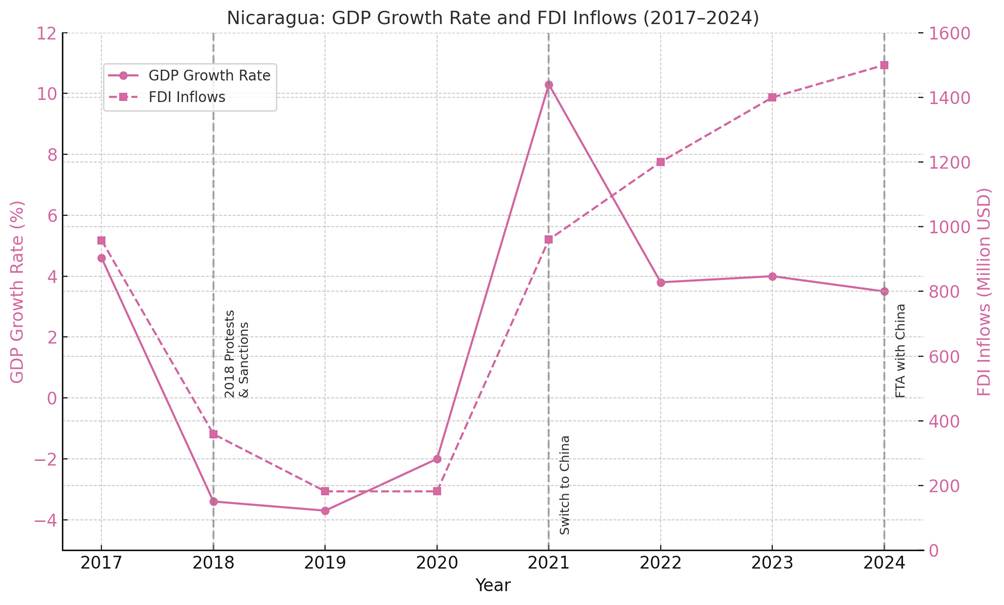
Figure A then shows a sharp rebound in 2021: FDI surged from $182 million to $960 million in a single year, and Nicaragua’s GDP growth rate soared to roughly +10%. This dramatic spike reflects a combination of post-COVID recovery and early signs of China-backed economic engagement. Formal recognition of Beijing occurred at the end of 2021, meaning that the original rebound in 2021 was not directly caused by formal realignment with China. Rather, the graph shows that the rebound helped create the momentum and political conditions in which Ortega pursued deeper economic ties with China. However, the slower growth in 2022 reveals the limits of that recovery in the face of persistent sanctions, fragile institutions, and limited diversification in international partnerships.
This finding supports Hypothesis #1: Nicaragua’s foreign policy realignment with China is driven by political survival in the face of U.S. sanctions and diplomatic isolation. From a realist perspective, a state’s first priority is survival. When Nicaragua could no longer depend on the United States or its multilateral allies for financial support, it made the most rational choice available—reaching for a lifeline from China, a state that does not condition aid on democratic reforms or human rights compliance.
Castling out the west: Nicaragua’s embassy and consulate closures and openings
In the diplomatic sphere, Nicaragua has been withdrawing from its traditional allies and retreating from Western institutions that once formed the foundation of its international relations. On the chessboard, this is known as “castling”—a defensive maneuver that requires calculated repositioning to protect the king. The Ortega-Murillo regime’s systemic closures and openings of embassies and consulates are a direct reflection of its strategic realignment away from Western scrutiny and toward ideological solidarity with authoritarian powers like China, Russia, and North Korea. The international condemnation, sanctions, and isolation following the 2018 protests threatened Ortega-Murillo’s powerful grip on Nicaragua, prompting a diplomatic repositioning that aligns strongly with Hypothesis #1.
These diplomatic moves, however, are not solely evidence of Ortega-Murillo’s survival instinct. The closure and redirection of Nicaragua’s diplomatic offices also position the country as a useful geopolitical foothold for China in the Western Hemisphere, reinforcing Hypothesis #2. The shutdown of embassies in U.S.-aligned democracies and the opening of new ones in Beijing, Pyongyang, and across Africa signal Nicaragua’s deepening role in China’s global strategy to undermine U.S. influence and build a network of ideologically aligned partners. As the Ortega regime retreats from the liberal international order, it simultaneously becomes more embedded in an emerging bloc led by authoritarian powers:a shift that offers both political protection and strategic value to its new patrons. As Laureano Ortega-Murillo, son of the presidential couple and presidential investment advisor, declared, Nicaragua is embracing “the end of the global dictatorship of the dollar” and participating in the “new world that is being formed,” led by China, Russia, and Iran (Confidencial, 2023).
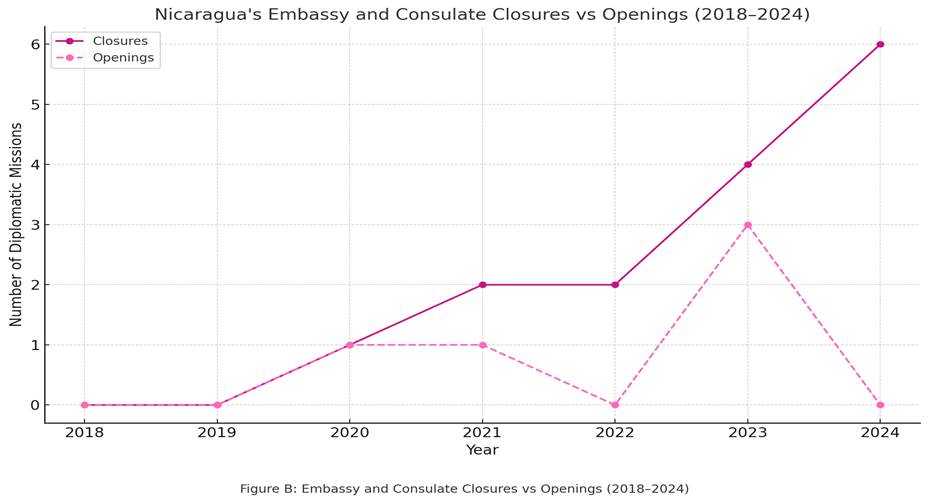
Since 2020, Nicaragua has slashed its diplomatic footprint in democratic and Western-aligned countries. The closure trend began in 2020 with the embassy in Quito, Ecuador (Confidencial, 2020). In 2021, embassies in Taipei and Belize were shut down following Nicaragua’s decision to sever diplomatic ties with Taiwan and reestablish relations with the People’s Republic of China (Al Jazeera, 2021). In 2022, the embassy in The Hague, Netherlands, and the consulate in Chinandega, Costa Rica, were also closed (Confidencial, 2022). This retreat accelerated in 2023 with the closure of the embassy to the Vatican after escalating tensions between the Ortega regime and the Holy See (Agren, 2023). In 2024, embassies in Berlin and Seoul followed suit, alongside sweeping consulate closures in U.S. cities like Los Angeles, Houston, New Orleans, and San Francisco, as well as in Tapachula, Mexico (Confidencial, 2024).
This sweeping reduction in diplomatic presence reflects both practical disengagement from Western partners and a strategic repositioning toward regimes less critical of Ortega’s authoritarianism. Figure B illustrates the trajectory of Nicaragua’s diplomatic transformation, with embassy and consulate closures consistently outpacing new openings since 2020. The stark divergence in 2024 visually captures the culmination of Nicaragua’s “castling” strategy—pulling back from long-standing alliances and shifting its weight toward authoritarian partners.
This diplomatic restructuring has also had grave consequences for Nicaraguans abroad. With consulate closures across the U.S., citizens now face longer travel times and greater financial burdens to renew passports or access basic services (Confidencial, 2024). Critics argue that this is part of a broader pattern of TNR—a tactic increasingly used by authoritarian regimes such as Nicaragua to monitor, intimidate, and disenfranchise their exiled populations. According to the Human Rights Watch (2023), the Ortega-Murillo regime has escalated efforts to revoke citizenship, deny documentation, and intimidate Nicaraguans living in exile. By making life more difficult for Nicaraguans abroad, especially exiled critics,the regime mirrors the playbook of its new allies in Beijing, who are also known to resort to TNR, weaponizing diplomacy to control dissent beyond their borders.
Yet even as Nicaragua retreats from the democratic world, it has not withdrawn entirely from global affairs—it has simply redesigned its diplomatic map. In December 2021, just days after severing ties with Taiwan, Nicaragua reestablished full diplomatic relations with the People’s Republic of China and welcomed the reopening of the Chinese embassy in Managua (Hale, 2021). In 2023, the Ortega-Murillo regime expanded its global reach by opening embassies in Zimbabwe, Angola, and Burkina Faso (Divergentes, 2023), followed by the dramatic launch of a new embassy in Pyongyang, North Korea (Confidencial, 2023). These openings are more than symbolic—they are deliberate steps toward deepening ideological and strategic alignment with authoritarian regimes.
Material imbalance: trading low value for high leverage
In chess, a material imbalance occurs when a player trades a high-value piece for something less powerful in return. However, a skilled player may willingly sacrifice that piece in exchange for positional advantage. China’s partnership with Nicaragua reflects a similar strategy.
A highlight of Nicaraguan state media in recent years has been its promotion of the supposed economic benefits of the Nicaragua–China relationship, from joining the Belt and Road Initiative in 2022 to the signing of a free trade agreement in 2024 (Maizland, 2023). These developments stem from the Ortega-Murillo regime’s longstanding desire to reduce its dependency on the United States—its largest trading partner. While it is certainly not in their interest to depend on any major power, shifting economic reliance to a state that does not impose sanctions based on governance style ensures that the FSLN remains firmly in control. This logic supports Hypothesis #1, yet the following chart helps confirm Hypothesis #2 as well.
China’s presence in Latin America is typically viewed through the lens of economic expansion, particularly with ambitious Belt and Road projects and the subsequent debt trapping. However, trade data illustrated in Figure C reveals that, compared to regional giants like Brazil, Mexico, and Chile, Nicaragua’s trade volume with China is significantly weaker (World Bank WITS, 2024; UN Comtrade, 2024; ECLAC, 2023; Nicaraguan Ministry of Development, Industry and Trade, 2024).
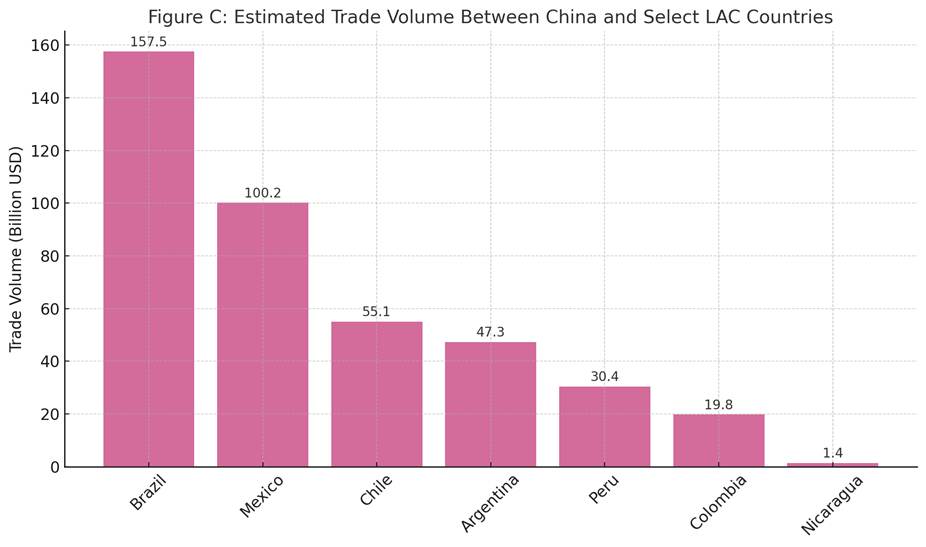
*The countries selected to compare with Nicaragua represent a broad variety of economic scales, political alignments, and levels of engagement with China—ranging from U.S. allies like Colombia and Mexico, to more ideologically flexible or China-leaning states like Argentina and Brazil.
In other words, China does not have much to gain from partnering with Nicaragua—at least not in fiscal terms. This obvious disparity reinforces the notion that China’s interest in Nicaragua is not primarily economic, but strategic. Despite its meager market size, Nicaragua’s geopolitical location, willingness to support China diplomatically, and ideological alignment make it a valuable piece on China’s side of the board. After all, what is the difference in value between a bishop and a pawn, if either can help secure the opponent’s checkmate?
The bishop’s diagonal: mapping China’s strategic moves in the Western Hemisphere.
China’s influence in Nicaragua is subtle, precise, and strategic—like the long-range diagonal movement of a bishop, which can quietly dominate the board if left unchecked. Unlike a pawn or knight, the bishop plays a long game, striking from afar and often catching opponents by surprise. Strategically speaking, China’s engagement with Nicaragua mirrors this maneuver. As previously established, Nicaragua offers little in terms of market value. Yet, it ranks among the most strategically aligned states in Latin America. Through security training, diplomatic realignment, and ideological synchronization, China has quietly constructed one of its most reliable regional partnerships—not by virtue of economic scale, but by leveraging ideological loyalty and geopolitical proximity. This pattern, though subtle, reveals the growing depth of China’s influence in Latin America, particularly among authoritarian-leaning regimes seeking powerful allies unconcerned with human rights or democratic norms.
Since reestablishing formal ties in December 2021, China and Nicaragua have developed a deeply integrated security relationship across multiple dimensions. Cooperation began with donations of riot gear and police vehicles in 2022, and quickly expanded into direct police training, forensic instruction, and the provision of surveillance equipment—including facial recognition technology, drones, and cyber-monitoring software (Artículo 66, 2023; Confidencial, 2023; El 19 Digital, 2022; Havana Times, 2024). In 2023 and 2024, Chinese instructors led joint courses in Managua on policing tactics, digital forensics, and convoy security—training that Co-President Murillo praised as evidence of Nicaragua “learning from China’s good practices” (Prensa Latina, 2024). These surveillance tools were paired with technical guidance from China’s Ministry of Public Security, which dispatched political security officials to mentor Nicaraguan authorities in political repression and state security (Artículo 66, 2024).
High-level military ties have also intensified. In late 2023, General Julio César Avilés visited Beijing to participate in the Xiangshan Forum a semi-annual forum hosted by China to discuss international security cooperation (Jiao, 2018), and shortly afterward, the People’s Liberation Army (PLA) sent its first formal delegation to Managua in decades. These exchanges culminated in the December 2023 announcement of a “strategic partnership” between Ortega and Xi Jinping—one that emphasized security and defense cooperation (República 18, 2023). China is reportedly preparing future arms transfers and has trained Nicaraguan officers in drone surveillance and riot control. Intelligence-sharing on terrorism, narcotrafficking, and cyber threats has also become a key feature of bilateral police and military agreements (Confidencial, 2024; Diálogo Américas, 2023). These developments place Nicaragua among a small group of Latin American states that are not only diplomatically, but also strategically, aligned with Beijing’s security governance model.
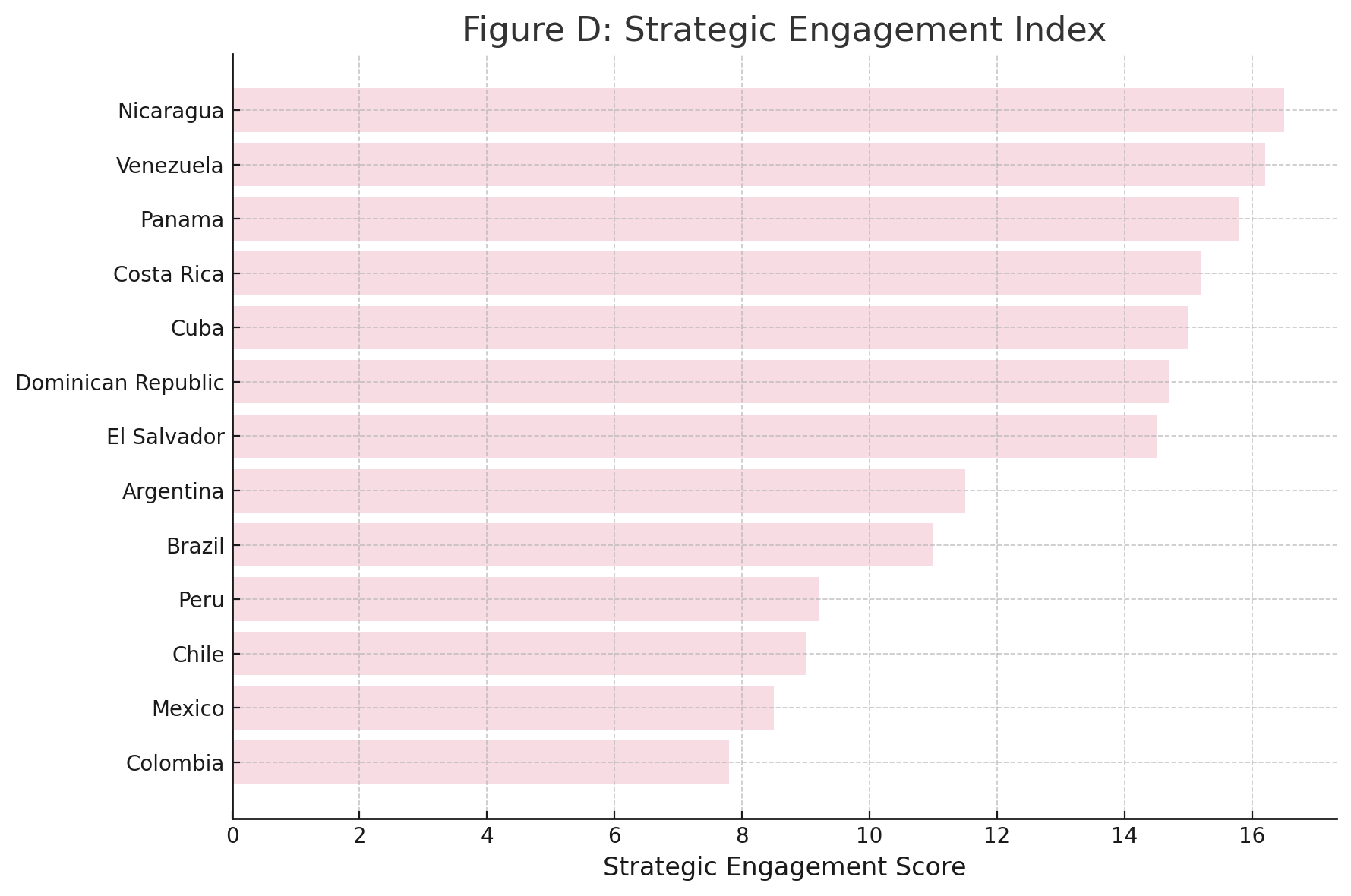
To test Hypothesis #2 more systematically—that Nicaragua’s relationship with China serves primarily strategic purposes rather than economic ones—Figure D presents a Strategic Engagement Index, a composite scoring model based on seven measurable indicators of China–LAC alignment. These indicators include: (1) participation in China’s Belt and Road Initiative (BRI); (2) recognition of the People’s Republic of China over Taiwan; (3) documented military or police training with China; (4) confirmed donations or transfers of Chinese security equipment; (5) existence of a Chinese military attaché or high-level security visits; (6) a formal security or policing agreement; and (7) consistent UN voting alignment with China and against the United States (Council on Foreign Relations, 2023; Department of State, 2023; Ellis, 2024; The Diplomat, 2023, 2024; Confidencial 2023, 2024; Al Jazeera, 2021; Human Rights Watch, 2024; Xinhua, 2023). Each country receives one point for every indicator met, creating a grounded, side-by-side comparison of how deeply China is engaged in the region beyond trade alone.
By synthesizing this data into a single visual score, the index clarifies where Nicaragua stands relative to larger economies like Brazil or U.S.-aligned states like Colombia—demonstrating that, despite its small size, Nicaragua ranks among the most strategically integrated partners of China in the Western Hemisphere, further reinforcing the notion that Nicaragua—above all else—is of strategic value to China rather than economic.
Black versus white: Nicaragua’s UN voting records
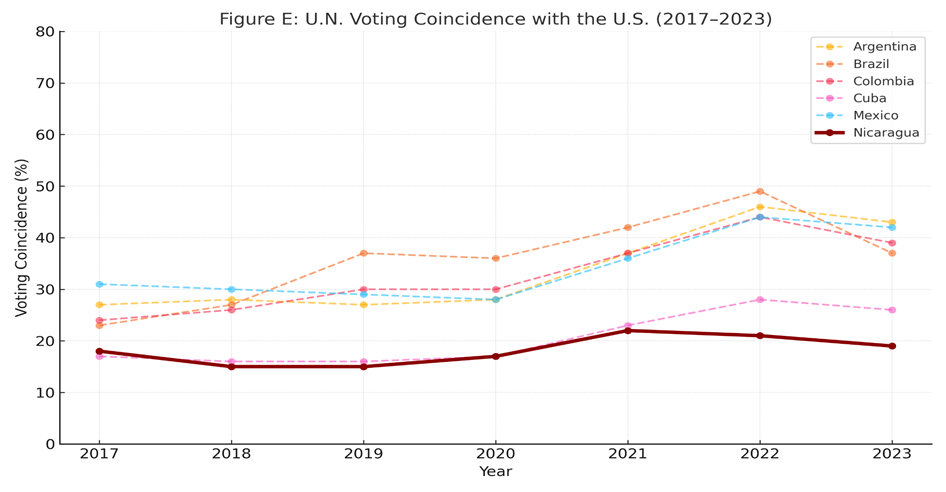
UN voting records are a key indicator of a member state’s foreign policy objectives and diplomatic alignments. Each year, the U.S. Department of State releases a comprehensive report on how UN member states vote in comparison to the United States in both the UN General Assembly and the UN Security Council. The State Department uses “voting coincidence” as a primary metric—measuring the overall percentage of times a country’s votes align with those of the U.S. Ultimately, these reports are used to assess diplomatic engagement with U.S. positions on a wide range of international issues.
Voting alignment with any country is often shaped by multiple factors, including ideology (e.g., democracy, human rights, and the rule of law versus authoritarianism and repression), pre-existing alliances, such as NATO or the G7, and strategic partnerships (particularly among countries reliant on great powers such as the U.S. or China for military or economic support). While not a perfect measure of a country’s foreign policy nuance, voting coincidence offers valuable insight into Nicaragua’s ongoing drift away from the United States.
Although the “Voting Practices in the United Nations” reports only provide data on voting coincidence with the U.S., the inverse can be reasonably inferred: a persistently low alignment with the U.S. often suggests increased alignment with states like China and Russia—especially on contentious global matters. Figure E displays Nicaragua’s voting patterns alongside a selection of other LAC countries to highlight its outlier status. For the most part, Nicaragua maintains a consistently low voting coincidence rate (VCR) with the U.S., unlike Brazil and Mexico—China’s top economic partners in the region. Instead, Nicaragua’s alignment mirrors that of Cuba, a long-standing U.S. adversary.
The chart alone, however, doesn’t fully capture the depth of Nicaragua’s realignment. According to State Department reports, Nicaragua has been listed in the “Adversaries” section every year since 2018 for ranking among the ten countries with the lowest VCR. In the immediate aftermath of the 2018 protests, Nicaragua placed 5th lowest (Department of State, 2018–2020). By 2021, it rose to 4th. And in the most recent reports, Nicaragua has held the position of 2nd lowest VCR—surpassing even Iran, Cuba, Russia, and other well-known U.S. adversaries. These patterns strongly reinforce Hypothesis #1, as Nicaragua’s declining alignment correlates with mounting U.S. sanctions and deepening diplomatic isolation. They also affirm Hypothesis #2, as the shift coincides with intensified ties to China—a country that rewards political loyalty with investment, diplomatic cover, and ideological affirmation.
While direct UN voting alignment data with China is unavailable, media evidence suggests that Nicaragua has voted alongside China and its allies on controversial issues. Notably, during the UN Human Rights Council vote on the Xinjiang Human Rights Resolution—a U.S.-backed motion to debate the situation in Xinjiang—Nicaragua was among the countries voting against the measure, siding with China (Qiao Collective, 2022). The Chinese government has been accused of carrying out systemic human rights abuses and cultural genocide against the Uyghur Muslims in the Xinjiang autonomous region, reportedly detaining over a million Uyghurs in so-called “reeducation camps” in the region (Maizland, 2025). Voting against a motion to investigate alleged genocide not only signals diplomatic alignment but also ideological endorsement—Nicaragua’s vote reflects more than neutrality; it arguably reflects agreement. Considering, however, Ortega-Murillo’s own track record with human rights violations, this should come as no surprise. Ultimately, Nicaragua’s voting behavior at the UN signals more than diplomatic divergence—it marks a deliberate strategic repositioning on the global chessboard. In abandoning the liberal-democratic “white squares” in favor of the authoritarian “black,” Nicaragua has joined China’s camp in a mounting contest of values, legitimacy, and influence.
Conclusion:
The evidence laid out in this study confirms that the Ortega-Murillo regime’s pivot toward China was not a mere economic detour, but a carefully calculated survival strategy in response to debilitating U.S. sanctions and international condemnation. As Figure A revealed, the Nicaraguan economy was left in shambles in the wake of the 2018 protests, and with harsh scrutiny from their primary international trading partners, the regime’s grip on power began to weaken. Confronted with both domestic upheaval and external isolation, Ortega-Murillo turned to Beijing for what Washington, Taipei, or any western or democratic power would no longer provide: legitimacy, investment, and protection.
At first glance, Nicaragua’s value to China may seem puzzling. After all, the findings in Figure C show that Nicaragua has little to offer to China economically–especially compared to other LAC countries. Yet, as realists understand, not all pieces on the board are chosen for their immediate value—some are positioned for their long-term leverage. Figure D, the Strategic Engagement Index, makes clear that Nicaragua has become one of China’s most deeply integrated allies in the Western Hemisphere, not because of its economic might, but because of its geographic and ideological utility.
Like a bishop quietly cutting across the board, China’s influence in Nicaragua has advanced diagonally: not with fanfare, but with steady, strategic moves. Beijing has trained police forces, provided surveillance tools, supported political repression, and begun to build a reliable intelligence-sharing network. These developments echo Cold War alignments–similar to Cuba’s strategic location, and its alignment with the USSR.
Meanwhile, Nicaragua’s UN voting record has drifted ever further from Washington and closer to Beijing, signaling not just a shift in economic alliances, but a broader ideological consensus. As the chessboard resets for a new era of global competition, Nicaragua is no longer simply a pawn in Latin America’s long-standing dependency on great powers. It is now a bishop on China’s flank—capable of quietly shifting the balance of influence in the hemisphere.
If current trends hold, the Ortega-Murillo regime may become a model for how small authoritarian states can leverage the great power rivalry to their advantage. This poses a growing challenge for U.S. foreign policy in the region, especially as it grapples with its rivalry with China and its southern border crisis. The more Washington isolates regimes like Nicaragua, the more tightly they may coil around Beijing. And as China refines its tactics: offering aid with no strings, surveillance with no accountability, and partnerships with no democratic demands—it will find willing partners among those who seek control more than freedom.
Ultimately, this study suggests that Nicaragua’s alignment with China is not an anomaly—it is a sign of the international chessboard shifting. In this new global contest, survival may no longer depend on ideology or economics alone, but on how well a regime can reposition itself in a game where loyalty is traded for power, and small moves lead to global consequences. The king is protected, the pawns are sacrificed—and the bishop remains quietly in play, waiting for the perfect strike.
Appendices
Appendix A. U.S. Sanctions on Nicaragua (2018–2023)
| Year | Sanction/Action | Source |
| 2018 | NICA Act signed into law (December 2018), restricting loans to Nicaragua through international financial institutions. | U.S. Department of State, 2018 |
| 2019 | Global Magnitsky Act sanctions placed on senior Nicaraguan officials and state-owned enterprises for corruption and human rights abuses. | U.S. Department of Treasury, 2019 |
| 2020 | Additional OFAC sanctions targeting the banking sector and businesses closely tied to President Ortega. | U.S. Department of Treasury, 2020 |
| 2021 | RENACER Act passed, expanding sanctions to include Nicaragua’s military and police, and tightening restrictions on international financing. | Congressional Record, RENACER Act 2021 |
| 2022 | Visa bans, asset freezes, and additional Magnitsky sanctions extended to Ortega regime affiliates. | U.S. Department of State, 2022 |
| 2023 | Enforcement of existing sanctions continued, but no major new sanctions were introduced during this period. | U.S. Department of State, 2023 |
Appendix B. Economic Indicators – Nicaragua (2017–2022)
| Year | GDP Growth Rate (%) | FDI Inflows (USD Millions) |
| 2017 | +4.6 | $843 |
| 2018 | -3.4 | $359 |
| 2019 | -3.7 | $392 |
| 2020 | -2.0 | $182 |
| 2021 | +10.3 | $960 |
| 2022 | +3.8 | $623 |
| 2023 | +4.3 | $695 |
| 2024 (est.) | +3.5 | $612 |
Sources: World Bank (2024), IMF (2024), Secretaría de Economía (2024), Statista (2023)
Appendix C. Strategic Engagement Index – China-LAC Security Alignment
| Country | # of Security Agreements | Signed BRI | UN Vote Alignment (Est. %) | Confirmed Training | Donated Security Equipment | Military Attaché in Beijing | Taiwan to PRC Switch | Total Score |
| Nicaragua | 2 | 1 | 9.5 | 1 | 1 | 1 | 1 | 16.5 |
| Panama | 2 | 1 | 8.8 | 1 | 1 | 1 | 1 | 15.8 |
| Venezuela | 3 | 1 | 9.2 | 1 | 1 | 1 | 0 | 16.2 |
| Costa Rica | 2 | 1 | 8.2 | 1 | 1 | 1 | 1 | 15.2 |
| Cuba | 2 | 1 | 9.0 | 1 | 1 | 1 | 0 | 15 |
| Dominican Republic | 1 | 1 | 8.7 | 1 | 1 | 1 | 1 | 14.7 |
| El Salvador | 1 | 1 | 8.5 | 1 | 1 | 1 | 1 | 14.5 |
| Argentina | 1 | 1 | 7.5 | 1 | 0 | 1 | 0 | 11.5 |
| Brazil | 1 | 1 | 8.0 | 0 | 0 | 1 | 0 | 11 |
| Peru | 0 | 1 | 7.2 | 0 | 0 | 1 | 0 | 9.2 |
| Chile | 0 | 1 | 7.0 | 0 | 0 | 1 | 0 | 9 |
| Mexico | 1 | 0 | 6.5 | 0 | 0 | 1 | 0 | 8.5 |
| Colombia | 0 | 0 | 6.8 | 0 | 0 | 1 | 0 | 7.8 |
References
Antunes, S. & Camisão, I. (2018). Introducing Realism in International Relations Theory. E-International Relations. https://www.e-ir.info/2018/02/27/introducing-realism-in-international-relations-theory/#google_vignette
Armony, V. & Velásquez, L. (2020). China-Latin America Relations and the Belt and Road Initiative: Economic and Strategic Implications. Journal of International Relations.
Artículo 66. (2023). China entrega donación de equipos a la Policía de Nicaragua. https://www.articulo66.com/2023/11/08/china-donacion-equipos-policia-nicaragua
Artículo 66. (2024). China exporta técnicas de vigilancia política a Nicaragua. https://www.articulo66.com/2024/05/03/china-vigilancia-nicaragua/
Audiovisuales Confidencial. (2023). Laureano Ortega Murillo predicts the end of the ‘global dollar dictatorship’. Confidencial. https://confidencial.digital/confidencialtv/laureano-ortega-murillo-augura-el-fin-de-la-dictadura-mundial-del-dolar-2/
Brown, T., & Smith, M. (2023). Geopolitical Shifts and Economic Power in Latin America: China’s Expanding Role. Latin American Politics and Society, 65(3), 109–124.
Chen, K. (2023). Taiwan unleashes fury at Nicaragua president for supporting ‘one China’ principle. Taiwan News. https://www.taiwannews.com.tw/news/5020449
Confidencial Editorial. (2020). Nicaragua cierra embajada en Quito. Confidencial.
Confidencial Editorial. (2022). Régimen deja ‘en el limbo’ a opositores exiliados al negarles pasaportes. Confidencial. https://confidencial.digital/nacion/regimen-deja-en-el-limbo-a-opositores-exiliados-al-negarles-pasaportes/
Confidencial Editorial. (2023). Nicaragua abre embajada en Pyongyang. Confidencial.
Confidencial Editorial. (2024). Closure of Consulates Generates More Expenses for Nicaraguans in the U.S. Confidencial. https://confidencial.digital/english/closure-of-consulates-generates-more-expenses-for-nicaraguans-in-the-u-s/
Confidencial Editorial. (2024). Nicaragua to Strengthen Surveillance With Support From Russia and China. Confidencial. https://confidencial.digital/english/nicaragua-to-strengthen-surveillance-with-support-from-russia-and-china/
Confidencial. (2022). Cierre del consulado en Chinandega refleja reducción diplomática. Retrieved from https://confidencial.digital
Confidencial. (2023). Cooperación policial entre China y Nicaragua avanza con nuevos cursos. https://confidencial.digital/nacion/cooperacion-policial-china-nicaragua/
Confidencial. (2024). Nicaragua profundiza colaboración con China en ciberseguridad. https://confidencial.digital/english/nicaragua-china-ciberseguridad/
Confidencial. (2024). Cierre de consulados en Los Ángeles, Houston y Nueva Orleans afecta a migrantes nicaragüenses. https://confidencial.digital
Confidencial. (2024). Nicaragua cierra embajadas en Berlín y Seúl como parte de nueva estrategia exterior. https://confidencial.digital
Council on Foreign Relations. (2023). China’s Massive Belt and Road Initiative. https://www.cfr.org/backgrounder/chinas-massive-belt-and-road-initiative
Department of State. (2022). United States – Central America – Dominican Republic Free Trade Agreement (CAFTA-DR). U.S. Embassy In Nicaragua. https://ni.usembassy.gov/united-states-central-america-dominican-republic-free-trade-agreement-cafta-dr/
Diálogo Américas. (023). China fortalece cooperación de seguridad con Nicaragua. https://dialogo-americas.com/es/articles/china-fortalece-cooperacion-de-seguridad-con-nicaragua
Divergentes. (2023). Nicaragua amplía su presencia en África. https://www.divergentes.com
Dos Santos, Theotonio. 1970. “The Structure of Dependence.” The American Economic Review 60(2): 231-236.) https://www.google.com/url?q=https://www.e-ir.info/2016/11/23/dependency-theory-a-useful-tool-for-analyzing-global-inequalities-today/&sa=D&source=docs&ust=1745091031096600&usg=AOvVaw0t4dOZUtabD1BkEu0jFLJr
Economic Commission for Latin America and the Caribbean (ECLAC). (2023). International Trade Outlook for Latin America and the Caribbean. Retrieved from https://www.cepal.org/en/publications/type/international-trade-outlook-latin-america-and-caribbean
El 19 Digital. (2022). Policía Nacional recibe donación de equipos de seguridad de China. https://www.el19digital.com/articulos/ver/titulo:124083-policia-nacional-recibe-donacion-de-equipos-de-seguridad-de-china
El 19 Digital. (2023). Nicaragua y China firman acuerdo de libre comercio. https://www.el19digital.com/articulos/ver/titulo:132324-nicaragua-y-china-firman-acuerdo-de-libre-comercio
Ellis, E. (2023). China’s Growing Strategic Position in Nicaragua – The Diplomat. The Diplomat. https://thediplomat.com/2023/12/chinas-growing-strategic-position-in-nicaragua/
Ellis, E. (2024). China’s Security Engagement in Latin America and the Caribbean. The Diplomat. https://thediplomat.com/2024/02/chinas-security-engagement-in-latin-america-and-the-caribbean/
Haglund, D. (2022). Sanctions and Foreign Policy: U.S. Measures and the Diplomatic Realignment of Nicaragua. International Political Science Review.
Hale, E. (2021). Nicaragua cuts diplomatic ties with Taiwan to align with Beijing. Al Jazeera. https://www.aljazeera.com/news/2021/12/10/nicaragua-breaks-ties-with-taiwan-to-align-with-beijing
Havana Times. (2024). Murillo celebra cursos policiales impartidos por China. https://havanatimes.org/espanol/murillo-celebra-cursos-policiales-china/
Human Rights Watch. (2019). Crackdown in Nicaragua: Torture, ill-treatment, and prosecutions of protesters and opposition leaders. https://www.hrw.org/report/2019/06/19/crackdown-nicaragua/torture-ill-treatment-and-prosecutions-protesters-and
Human Rights Watch. (2023). “You belong to your fatherland”: Transnational repression against Nicaraguans. https://www.hrw.org/report/2023/10/04/you-belong-your-fatherland/transnational-repression-against-nicaraguans
International Monetary Fund. (2024). World Economic Outlook Database. https://www.imf.org/en/Publications/WEO
Jiao, Q. (2018). 微视频|两分钟带你了解北京香山论坛, Ministry of National Defense of the People’s Republic of China. http://www.mod.gov.cn/gfbw/spbb_214126/djsp/4827393.html
Jones, A. (2022). Transnational Repression and Authoritarian Foreign Policies in Latin America. Global Politics, 30(4), 415-432.
La Prensa. (2024). Nicaragua y China firman contratos para la construcción de una planta fotovoltaica. https://www.laprensani.com/2024/10/04/economia/3386849-nicaragua-y-china-firman-contratos-para-la-construccion-de-una-planta-fotovoltaica
Lopez, I., & Lee, Y. (2019). Loan of $100 million from Taiwan gives lifeline to Nicaragua’s Ortega. Reuters. https://www.reuters.com/article/world/loan-of-100-million-from-taiwan-gives-lifeline-to-nicaragua-s-ortega-idUSKCN1Q901J/
Maizland, L. (2025). China’s Repression of Uyghurs in Xinjiang. Council on Foreign Relations. https://www.cfr.org/backgrounder/china-xinjiang-uyghurs-muslims-repression-genocide-human-rights
Maizland, L., & Chatzky, A. (2023). China’s Massive Belt and Road Initiative. Council on Foreign Relations. https://www.cfr.org/backgrounder/chinas-massive-belt-and-road-initiative
Meyer, L. (2023). Nicaragua’s Economic Relations with China: The Impact of Chinese Infrastructure Projects. The Journal of Latin American Economic Studies, 15(1), 33–49.
Miller, M. (2024). Promoting Accountability for Nicaraguan Officials – United States Department of State. State Department. https://www.state.gov/promoting-accountability-for-nicaraguan-officials/
Ministerio de Fomento, Industria y Comercio (MIFIC). (2024). Estadísticas de Comercio Exterior de Nicaragua. Retrieved from https://www.mific.gob.ni/
Morgenthau, H. (1948). Politics Among Nations: The Struggle for Power and Peace. Alfred A. Knopf.
Myers, T. (2024). Strategic Interests and Geoeconomics: Nicaragua’s Alignment with China. Journal of East Asian Studies.
Nicaragua y China firman contratos para la construcción de una planta fotovoltaica. (2024). La Prensa. https://www.laprensani.com/2024/10/04/economia/3386849-nicaragua-y-china-firman-contratos-para-la-construccion-de-una-planta-fotovoltaica
Observatory of Economic Complexity. (2024). Nicaragua trade data. https://oec.world
Oxford Business Group. (2023). Latin America remains a key focus of China’s Belt and Road Initiative. Oxford Business Group. https://oxfordbusinessgroup.com/articles-interviews/latin-america-remains-a-key-focus-of-chinas-belt-and-road-initiative/
Prensa Latina. (2024). China fortalece capacidades policiales de Nicaragua. https://www.prensa-latina.cu/2024/09/25/china-fortalece-capacidades-policiales-de-nicaragua/
Price, N. (2021). Nicaragua’s Breaking of Diplomatic Relations with Taiwan – United States Department of State. State Department. https://www.state.gov/nicaraguas-breaking-of-diplomatic-relations-with-taiwan/
Qiao Collective. (2022). The Xinjiang Controversy at the United Nations. https://www.qiaocollective.com/xinjiang-at-the-un
República 18. (2023). Ortega y Xi consolidan alianza estratégica con enfoque en defensa. https://www.republica18.com/nicaragua-xi-ortega-alianza-estrategica/
Rostow, W. (1960). The Stages of Economic Growth. The Economic History Review.
Ruiz, J. (2021). Nicaragua’s Engagement with International Organizations: Multilateralism in the Context of Authoritarianism. Latin American Review of International Relations, 19(2), 95-110.
State Department. (2017). Voting Practices in the United Nations – 2017 Report. https://www.state.gov/reports/voting-practices-in-the-united-nations-2017/
State Department. (2018). Voting Practices in the United Nations – 2018 Report. https://www.state.gov/reports/voting-practices-in-the-united-nations-2018/
State Department. (2019). Voting Practices in the United Nations – 2019 Report. https://www.state.gov/reports/voting-practices-in-the-united-nations-2019/
State Department. (2020). Voting Practices in the United Nations – 2020 Report. https://www.state.gov/reports/voting-practices-in-the-united-nations-2020/
State Department. (2021). Voting Practices in the United Nations – 2021 Report. https://www.state.gov/reports/voting-practices-in-the-united-nations-2021/
State Department. (2022). Voting Practices in the United Nations – 2022 Report. https://www.state.gov/reports/voting-practices-in-the-united-nations-2022/
State Department. (2023). Voting Practices in the United Nations – 2023 Report. https://www.state.gov/reports/voting-practices-in-the-united-nations-2023/
Staten, C. L. (2010). The history of Nicaragua. ABC-CLIO.
Staten, R. (2020). Historical Roots of U.S.-Nicaragua Relations: From Somoza to Ortega. Journal of Diplomatic History, 34(2), 105-123.
Statista. (2023). Nicaragua Foreign Direct Investment. https://www.statista.com/statistics/805147/nicaragua-foreign-direct-investment/
Agren, D. (2023). Nicaragua closes embassy to the Vatican amid mounting tensions. The Boston Pilot. https://www.thebostonpilot.com/article.asp?ID=195717
Tico Times. (2024). China to Build Massive Solar Power Plant in Nicaragua. The Tico Times. https://ticotimes.net/2024/04/30/china-to-build-massive-solar-power-plant-in-nicaragua
U.S. Department of Treasury. (2024, May 15). Treasury Sanctions Nicaragua-Based Russian Institution and Gold Companies. U.S. Department of Treasury. https://home.treasury.gov/news/press-releases/jy2339
UN Comtrade. (2024). Trade statistics database. https://comtrade.un.org/
Walker, S. (2020). U.S. Sanctions and the Shifting Alliances of Nicaragua: The Path Toward China. The Journal of Latin American Foreign Policy, 12(3), 201–218.
Weber, M. (2025). Human Rights and Anti-Corruption Sanctions: The Global Magnitsky Human Rights Accountability Act. Library of Congress. https://www.congress.gov/crs-product/IF10576
World Bank. (2024). Open Data: Nicaragua. https://data.worldbank.org/country/nicaragua
World Bank. (2024). World Integrated Trade Solution (WITS). Retrieved from https://wits.worldbank.org/
Wu, H. (2021). Taiwan loses diplomatic ally Nicaragua to China. AP News. https://apnews.com/article/china-taiwan-central-america-nicaragua-2ab78e720661de32178796017c73999a
Xinhua Español. (2022). China y Nicaragua firman memorando de entendimiento sobre cooperación en la Franja y la Ruta. https://spanish.news.cn/20220712/e768b6fc75444ed9b157fbb51a471d6e/c.html