
By Ryn Johnson
Introduction
Emperor Napoleon Bonaparte I is renowned as a symbol of French strength and pride. During his reign, Napoleon used visual culture to craft an image of himself with the assistance of successful artists and architects of the time, including Jacques-Louis David and Jean-Francois-Therese Charlgrin. The iconic Napoleonic image consists of a highly dramatized and romanticized interpretation of the Emperor framing him as a decorated general and successor to the great Roman leaders, Charlemagne and Gaius Julius Caesar. After the collapse of the Napoleonic era and return of the Bourbon monarchy, historians have argued that this image was romanticized by the public as a result of collective longing for the return of revolutionary ideals, placing Napoleon as the symbolic figurehead of the Revolution. With the fluctuating political instability of early 19th-century France, the image shifted reflecting the political climate and agenda of the reigning regime.
After the Revolution of 1830 and the rise of the July Monarchy (the name for the constitutional monarchy that ruled France from 1830 to 1848 when it was overthrown by revolutionaries during the Revolution of 1848), the new king Louis-Philippe branded himself as the ‘Citizen King.’ As a newly established monarch, the King’s regime attempted to imitate the political framework of Napoleon by situating himself as the next protector of liberal values, similarly to Napoleon’s use of Roman imagery as the emperor. As a product of the House of Orleans–a cadet branch (a branch of a royal family that consists of a ruler’s younger sons) of the Bourbons (the royal dynasty that ruled France until 1792 when they were first disposed during the French Revolution, they would come back to power in 1815 following Napoleon’s defeat) –Louis-Philippe and his council worked to frame him as a successor to the Emperor in an effort to unite the nation under his rule.
The new regime aimed to gain public support through remembrance and nationalism. However, this political method, while more liberal than the ones prior, was ultimately not enough to satisfy the hunger of French liberalism, leading to the Revolution of 1848 and establishment of the Second Republic. This method of consolidation through nationalistic remembrance reveals how these regimes politically designed an image of a monarch through visual culture and how that image reflects the political environment of the era and agenda of the regime.
Historians studying French history have varying interpretations of how the Napoleonic regime legitimized and consolidated power in the aftermath of the chaos from the 1789 Revolution through visual propaganda. Scholars have broken down the fundamental roles and structures of art in the regime and emphasized the significance of his imperial image and how the public celebrated the return of the empire. Art historians draw particular attention to the emerging Neoclassical style perfected by Jacques-Louis David, First Painter to the Emperor.
Art historian Edgar Munhall discussed several notable portraits David had painted to provide a visual representation of the power of the regime in his article: “Portraits of Napoleon.” Munhall compared the styles of the famous Jacques-Louis David with his students, Baron Antoine Gros and Jean-Augustine Dominique Ingres, to emphasize the distinct artistic interpretations of the Emperor. Munhall observed how David’s approach “…retains a personal enthusiasm towards his, setting up around Napoleon a complex, anecdotal situation suggestive of self-sacrifice and indefatigable concentration.”1 He cited paintings like The Coronation of Napoleon and the Coronation of Empress Josephine (1805-1808), and Napoleon Crossing the Saint-Bernard (1800). Munhall proposed that the study of Napoleonic portraiture revealed “…the idealization each artist introduced into his portraits, ranging from the intense, introverted studies of the young general to the imposing figure of the Emperor.”2 By analyzing the visual interpretations, Munhall makes it clear that the Neoclassical style was exploited by Bonaparte to elevate his imperial image.
Art historian Albert Boime built upon Munhall’s analysis in his claim that David assisted Napoleon in building a propaganda campaign romanticizing the Emperor. In his book, Art in the Age of Bonapartism, Boime clearly laid out the artistic representations that placed Napoleon as Europe’s next leading autocrat and successor to Julius Caesar and Charlemagne.3 Boime suggested that Bonaparte’s reign signaled a return to the “ancient patriarchy” evident in Napoleon’s act of self-coronation. An act which Boime argued “…demonstrated the firm control Napoleon had over Europe and his own country.”4 Boime presented the claim that Napoleonic art was intended to display and portray the power of the Emperor, with neoclassicism as the vehicle to demonstrate such control.
Outside traditional paintings, in his analysis of Napoleonic art, Boime briefly mentioned the role of architecture in this political scheme to unite and consolidate power. He drew specific attention to the Arc de Triomphe de l’Étoile for its symbolism representing the honor and strength of the imperial army. Boime acknowledged the strategic political design highlighting scale, style, and location of the monument to grasp just how deliberate the regime was in and crafting this image.5 Boime asserted that the regime used political imagery to intimidate and subordinate the populace to maintain power thus creating a propaganda machine through this imperial vision.
Historians have built upon Boime’s analysis of art focusing on the role of physical visual manifestations commissioned under the imperial regime. Art historian Diana Rowell examined the ways in which Napoleon transformed Paris into an “imperial metropolis” in her book, Paris: The “New Rome” of Napoleon I. She agrees with fellow art historians Boime and Munhall about the political intentions behind the art, arguing that Bonaparte transformed Paris into a “visual paradigm of Napoleon’s rule as emperor and a potent vehicle through which to display his unparalleled authority.”6 Rowell dissects both the triumphal arches the Arc de l’Étoile (1806-1836) and Arc de Triomphe du Carrousel (1806-1808), both located in Paris and symbolic of the Emperor and his imperial army. While similar in name and form, the sheer stature and intent of each piece further illustrates the significance of visual politics in the unification and consolidation of power. Rowell argued that the inspiration behind the Roman arches, “…celebrated and displayed, in a highly visual manner, the ideology of victory and dynastic authority…”—a message she claimed the style translated into a “universal context.”7 This architectural style was designed to intimidate with its sheer size; in the heart of Paris, these monuments aimed to project the absolute power of the emperor. Rowell’s analysis frames these architectural feats as physical manifestations of Napoleon’s political vision, intended to promote pride in the army and assert dominance over the public.
In the wake of the Revolution of 1830, the July Monarchy sought to legitimize itself by engaging with France’s revolutionary legacy through symbolic and visual means. Historian Stanley Mellon examined the actions of King Louis-Philipe in his article, “The July Monarchy and the Napoleonic Myth,” specifically mentioning the king’s desire to, “be the first French ruler since the revolution to accept and honor all of the national past.”8 Mellon tracked the King’s efforts to contextualize himself in a line of great leaders of France claiming that, “…the July Monarchy was strong enough and flexible enough to absorb Napoleon and his glory.”9 Mellon constructs his argument by examining how the king sought to unify the public by reviving imperial nostalgia and aligning himself with revolutionary principles through a liberal portrayal of Napoleon. Mellon argued that the July Monarchy not only revitalized but grew the Napoleonic legend for the sake of pausing political imbalance citing how the king was chosen because, “…he represented both traditions of royal and revolutionary France.”10 This interpretation assists in understanding how the monarchy followed in the footsteps of the Napoleonic regime in the effort to fortify authority over the French state.
The groundwork provided by art historians reveals the ideological intentions and political visions of both the Orleanist and Napoleonic regimes. While art historians have established these visions, political historians have debated the role of nationalism in the construction of political imagery. Many of these historians lean into the view that Napoleon was a power hungry tyrant who continued his imperial campaign for his own egotistical gain. Historian Hans Kohn proposed a rationale for Napoleon’s authoritarian image claiming in his article, “Napoleon and the Age of Nationalism,”that post-revolutionary France, “longed for a strong man who would safeguard the main achievements of the Revolution in orderly security and stability…”11 In the fragile early days of the new republic, Kohn argued that the military was the only force with the “prestige and power” to restore order, and among all the young French generals, Napoleon appeared the most promising. Kohn further contended that Bonaparte had little interest in nationalism and instead gained support by presenting himself as a rational servant of the state. Kohn conceptualizes Napoleon’s reign as a fundamental building block in the development of 20th century fascism. He argues that unlike 20th century dictators, Napoleon did not need to rely on propaganda and made little to no attempt to sway public opinion due to his lack of use of accessible media like newspapers, pamphlets, and popular reports of his military victories.
Kohn’s claim suggests Napoleon’s reign foreshadowed what was to come, suggesting that Napoleon was a precursor to the age of nationalism. An age he suggested was spearheaded by the desire for a universal empire, an autocratic idea later attempted by Vladimir Lenin and Adolf Hitler. Kohn’s interpretation suggests that Napoleon “had no use for nationalism and the new popular forces…he believed in the state, in direction from above, in efficiency and rational order…His primary end was not the welfare of his subjects…[but] the perpetuation and glory of his dynasty.”12 Kohn’s interpretation conflicts with that of art historians calling into question the functional application of political imagery as either an active tool in the construction of his empire or simply the universal language to demonstrate such control.
Following Napoleon’s fall, his image continued to evolve, shaped by the political instability and competing ideologies of 19th century France. Political historian Sudhir Hazareesingh explored this shifting legacy, arguing that Napoleon’s memory underwent a liberal transformation after his death, particularly with the publication of his memoirs. In his article, “Napoleonic Memory in Nineteenth-Century France: The Making of a Liberal Legend,” Hazareesingh claimed that under the Napoleonic regime, liberal elites spoke out against the authoritarian direction of the nation. However, during Napoleon’s return during the Hundred Days (the period from roughly March, 1815 to July, 1815 where Napoleon briefly returned from his exile on the island of Elba to rule France, the Hundred Days were marked by the War of the Seventh Coalition, Napoleon’s defeat at the Battle of Waterloo, and ended with Napoleon’s surrender to British Royal Navy officer Sir Frederick Lewis Maitland aboard the HMS Bellerophon on July 15, 1815), Hazareesingh draws on the political writings of liberal leader Benjamin Constant to assess the dilemma faced by French liberals. In March of 1815, they were caught between “the threat of a restored Napoleonic dictatorship, the possibility of a royalist counterrevolution, and the near certainty of an invasion of its national territory by foreign armies.” Confronted with this peril, Constance argued that, “it was his civil duty to do all in his power to preserve his country’s freedom–even if that meant serving Napoleon.”13
Napoleon’s return during the Hundred Days and subsequent defeat at Waterloo marked a turning point, after which his memoirs, published posthumously, revealed both his heroic grandeur and the crippling humanity of the Emperor. Hazareesingh claimed, “…these memoirs completely transformed and liberalized the perception of the emperor, from autocratic tyrant dictator, to the modern face of liberalism and guardian of the revolution.”14 An image that Hazareesingh suggested the Orleanist’s sought to advance in their crusade for power stating how the new monarchy, “…quickly realized the capital they could draw from the Emperor’s extraordinary popularity in France.”15 Hazareesingh’s interpretation tracked the transcendence of the Napoleonic legend, situating it as an ideological manifestation of French greatness.
Following the groundwork laid by previous historians, this paper will examine Napoleon’s political iconography and its use as a stratagem to centralize authority throughout his reign. Political imagery played a central role in the propagandist campaigns of the early 19th century, especially in shaping the Napoleonic regime’s visual political strategies. This research analyzes key components of Napoleonic propaganda and compares them to the political imagery of both the Emperor and Citizen King. Historians have overlooked the ‘long century’ of French history and the role of iconographic political models in the creation of a centralized state, a model that was adapted by both the Napoleonic and Orleanist regimes. By tracking the transition of the Napoleonic legacy throughout the first half of the century, this paper explores how the Orléans adapted these visual strategies to create the image of the Citizen King.
Painting the Emperor: Jacques-Louis David and the Neoclassical Style 1800-1815
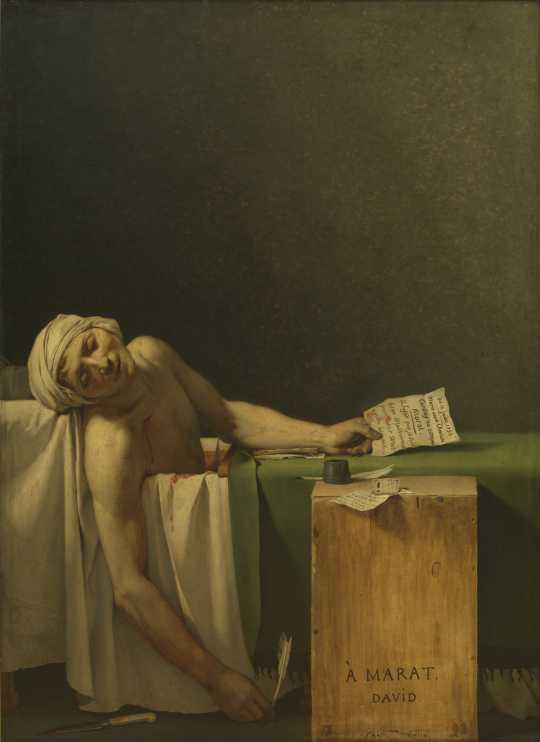
Traditional paintings held significant importance in the imperial political campaign of Emperor Napoleon Bonaparte. The Napoleonic regime partnered with renowned professional artist, Jacques-Louis David, to create this image through artistic displays. An expert in his field, David’s political iconography was fundamental for garnering public support, evident in his famous piece Death of Marat (pictured on the left) where David united and promoted revolutionary values in this depiction of radical revolutionary leader and member of the National Convention Jean-Paul Marat as a martyr for the revolutionary cause after his assassination in July, 1793.16 The painter jump started his artistic career after being awarded the highly accredited artistic scholarship, the Prix de Rome in 1774 during David’s time as a student at Académie royale de peinture et de sculpture (the Royal Academy of Painting and Sculpture), which gave him the opportunity to study in Rome where he familiared himself with the Classical Roman style. Napoleon and David worked as a team to manufacture the imperialist image which represented Bonaparte as the omnipotent autocrat and ruler in succession to the Roman Emperors. Trained in Roman iconography, David’s paintings worked to visualize and magnify Napoleon’s persona through the Neoclassical style. The first of his famous Napoleonic portraits, Bonaparte Crossing the Great Saint-Bernard Pass (pictured under this paragraph), more commonly known as Napoleon Crossing the Alps,17 presented David’s deliberate craftsmanship through inspiration of Roman imagery. Commissioned by King Carlos IV of Spain to facilitate peaceful relations with Napoleon who was then serving as the First Consul (the head of a three person triumvirate (a political institution lead by 3 members) known as the Consulate, the top level government that ruled the First French Republic from November 9, 1799 until May 18, 1804 when Napoleon was crowned “Emperor of the French” by the Senate), the work displays a rich, highly romanticized, perception mirroring the form and heroism of the equestrian statuette of Charlemagne, housed in the Louvre.18 David modeled his piece to adhere to the expansionist and autocratic worldview of the Romans. He recreated this style to signal and symbolize the birth of the new empire, elevating Napoleon as the leader ushering France into a wave of peace and stability through authoritarian force after the societal collapse of the revolution.
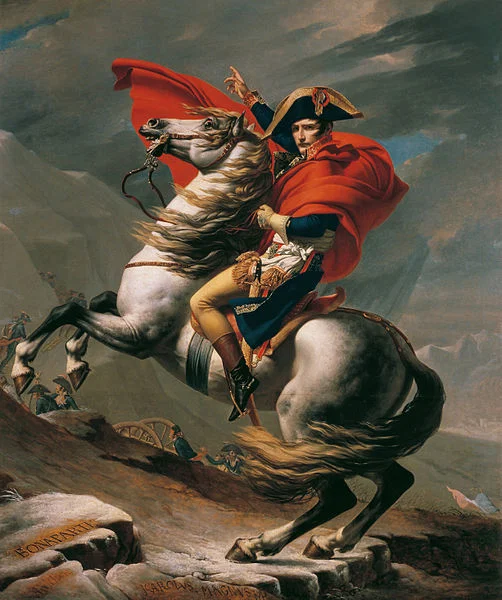
David’s painting functioned as a canvas to which the artist captured the regime’s political and imperial agendas. Art historians, like Boime, have studied this painting identifying the foundations of symbolism and Roman influence identifying how, “The four legs of the rearing animal point to a large slab of rock on the mountainside in which the name of Bonaparte is carved neatly in capital letters just above the more clearly rendered names of his processors who similarly mastered the treacherous Alpine crossing Hannibal and Karlous Magnus, (Charlemagne).”19 This common interpretation contextualizes the emperor as the next supreme conqueror with the Neoclassical style serving as a political instrument by embodying the greatness of Napoleon’s military leadership.
Historians have drawn attention to the sheer fabrication of this painting, noting that Bonaparte was on a mule rather than a horse–evidence of how David exploited the style to captivate audiences and fortify the valor of Napoleon and the French empire. While this painting ultimately represents French strength and imperial identity in the early days of the regime, David’s The Coronation of the Emperor and Empress (1805-7) (pictured under this paragraph) documents Bonaparte’s growing centralization of the state and dominance as a European autocrat.20 Boime highlighted this painting addressing the patriarchal connotations of the ceremonial framing of Napoleon as the new hegemon of the French state. He suggested that Bonaparte’s self-coronation signaled the return of “the machismo of ancient patriarchy, with himself exalted as immutable male authority.”21 This painting acts as a visual representation of the ceremony illustrating the significance of Napoleon’s act of self-coronation and coronation of his empress, once again parallelling Charlemagne. This action, merely unprecedented and shocking to the attendees, was actually staged by the regime and agreed to by Pope Pius VII.22 Historians have criticized the celebration, calling it a sham due to its theatrical nature; however, the painting ultimately served to cement Napoleon’s authority over the nation, exposing the manipulation behind the regime’s effort to forge the emperor’s legacy. Art historian Simone Lee wrote of the interaction between David and Napoleon in his book, David, in which the emperor expressed, “You have understood my thoughts, you have made me a French knight. I am grateful to you…”23 The emperor’s exploitation of political iconography, relied heavily on David’s mastery of romanticization and the neoclassical style to formulate a cult of personality. David’s artistry proved to be a vital lifeline for the regime by engineering Napoleon’s public image, providing a lens through which the population was subordinated to the sovereign.
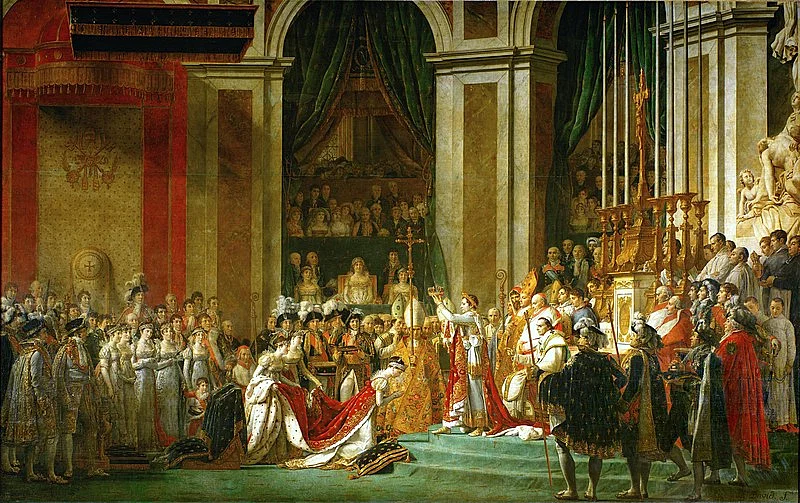
David and Bonaparte worked together to create the visual paradigm of the regime to which Louis-Philippe would later build off of. Analysis of David’s paintings clearly demonstrates the agenda and political weaponization of art to maintain authority. The reemergence of the Neoclassical style symbolized the regimes ideological regression of post revolutionary France while providing the foundation for the liberalization and posthumous romanticization of the emperor. The Coronation and Napoleon Crossing the Alps popularized and elevated Napoleon’s image further contributing to the regime’s mass propaganda campaign. These works reveal both how heavily the regime relied on art as a force of persuasion as well as the origination of the Napoleonic image as a whole.
While these iconic paintings presented a two-dimensional representation of the empire’s might, Napoleon also commissioned physical manifestations of French glory in the heart of Paris. Roman influence extended beyond traditional paintings, as the neoclassical style was employed to transform Paris into an ‘imperial metropolis’ that glorified Bonaparte. Grandiose architectural displays began to sprout around Paris for the purpose of celebrating the military and inciting nationalism within the French populace.
Constructing the Imperial Legacy: Empire Style
The Napoleonic regime acquired legitimacy through grandiose architectural displays, like the Arc de Triomphe, to symbolically reinforce Napoleon’s imperial power, thus demonstrating the cultural and governmental design central to his propaganda campaign. Ancient historian Andrew Wallace-Hadrill studied the significance of architecture in Rome declaring that, “Power does not exist without the language in which it is conceived and presented and argued over. Language defines power as well as reflecting it.”24 The Napoleonic regime was clearly aware of this in the construction of the imperial state. European architectural scholar Diana Rowell argues that Paris’s architectural transition was employed as a political instrument to subordinate the public and elevate Bonaparte. Coined “Empire Style,” the reemergence of Classical architecture provided the inspiration for neoclassicism in French structures. The construction of Napoleon’s edifices reinforced the regime’s efforts to emulate Classical power through the Roman celebratory Arch of Triumph.
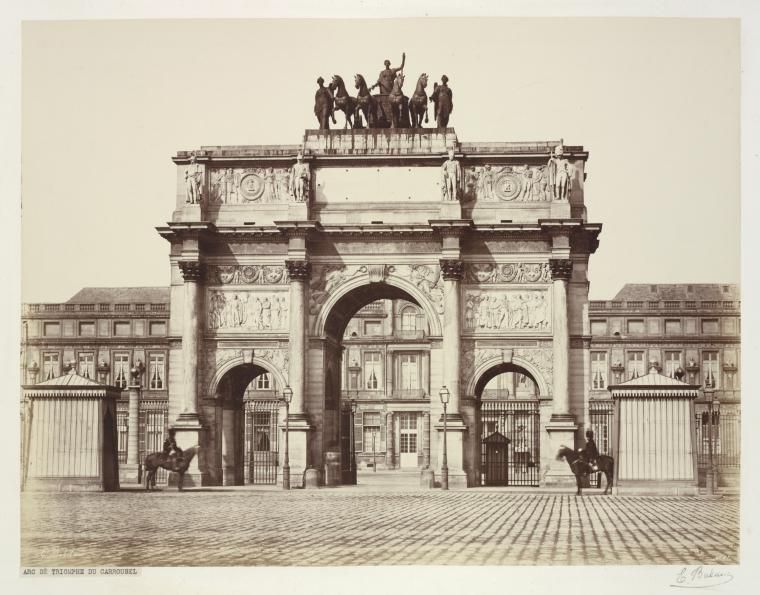
After the French military victory against the Austrians at the battle of Austerlitz in 1805, the emperor declared that his soldiers would return home through “arches of victory.” In an effort to celebrate France’s military dominance, the emperor commissioned four arches to be constructed in Paris, only two of which were ever built: the Arc de Triomphe du Carrousel and the Arc de Triomphe l’Étoile.25 The architects appointed by the government, Charles Percier and Pierre-François-Léonard Fontaine spearheaded the production and design of the monuments. Key figures in the development of Empire Style, Charles Percier and Pierre-François-Léonard Fontaine each won the Prix de Rome in the 1780s. These architects were chosen for this project because, like David, they were classically trained and equipped to bring to life the emperor’s vision. Like the paintings, the regime utilized the Classical style as a blueprint to centralize authority. The architects intentionally designed the Arc du Carrousel (shown in a photograph under this paragraph), replicating the exact proportions of the Arch of Septimius Severus in Rome offering further evidence of the Napoleonic regime’s deliberate allusions to antiquity.26 While this landmark appears miniscule compared to its more famous counterpart, the Arc du Carrousel stands at just 19 meters high. Historians have argued that the edifice’s location holds greater significance than its grandiosity. They emphasize that the structure’s original purpose was to connect the Tuileries Palace with the Louvre, serving as a ‘free-standing entrance’ to Bonaparte’s residence and government headquarters.27 The Arc du Carrousel represents Napoleon’s power on a micro-scale, acting as a stepping stone to the imperial legacy the emperor envisioned but never lived to witness. Rowell explained how Napoleon was unsatisfied with this structure due to its lack of nationalistic energy describing the structure as, “….more like a ‘pavillion’ than a triumphal arch.”28 This structure serves as an architectural foundation of Napoleon’s campaign efforts to employ visual culture for political gain: a playbook which Louis-Philippe will later take advantage of and reinvent in the 1830s.
While the Arc du Carrousel did not meet the emperor’s fantastical expectations, the Arc de Triomphe l’Étoile (shown in a photograph on the left) standing 50 meters high, was clearly more in line with Napoleon’s vision for an iconic arch radiating nationalism and French greatness.29 The structure was designed by architect Jean-François-Thérèse Chalgrin in 1806 and was not finished until decades after Napoleon’s death. While the Arc de Carrousel was attributed to the victory at Austerlitz, the Arc de Triomphe symbolized the power of the Grand Armée (Napoleon’s primary field army) and the growing strength of the empire. Boime acknowledged how, ‘Napoleon aimed to impress by building higher, more massively, and more ornately than his predecessors,’ highlighting a level of autocratic greed and a cult of personality. Bonaparte not only built an expansive standing army but also a militia of artists and architects, ready and willing to redesign Paris to properly reflect the sheer might of the emperor. Boime added that under his control, Bonaparte wielded two armies: one with which he “acquired territory and wealth, [and] with the other he acquired the means to express them.”30
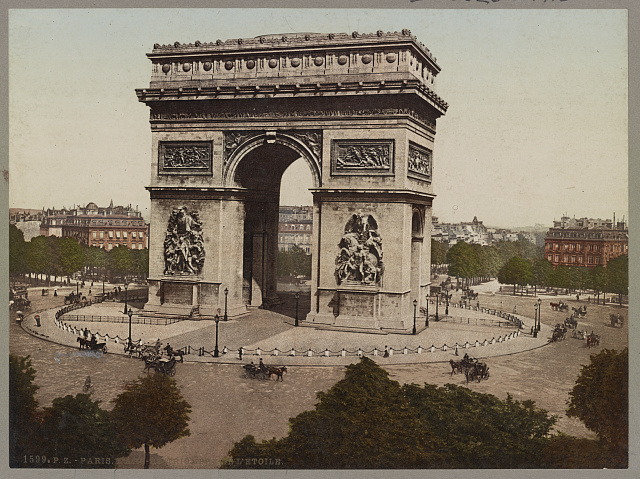
Though Napoleon did not live to see the completion of the great Arc de Triomphe, which was abandoned incomplete in 1814, the edifice has since been solidified as a major landmark dedicated to the Grand Armée with its grandiose nature reflecting the might of the military. Analysis of these architectural displays highlights Napoleon’s efforts to secure dominance with his passion for architecture as an outlet of expressing his supreme authority. Rowell commented on how architecture became a staple of his regime, writing how, “…it was said that the destruction of men and the construction of monuments were central to Napoleon, and that his passion for vast structures almost equaled that for war.”31 This interpretation of the regime’s employment of visual politics further exemplifies how Napoleon was not simply rising as a political figure, but was intentionally crafting an imperial empire, with Paris as the central focus of political vision.
The Napoleonic regime ultimately mastered the infusion of visual culture with political ambitions, evident in the architectural structures and elaborate paintings created under the emperor’s 15 year reign. Although Bonaparte worked to establish himself as an imperial leader, after his death and the restoration of the Bourbon monarchy, his image gained widespread admiration in the emerging Romantic era.
Liberalizing France: The Restoration and July Revolution 1815-1830
After Napoleon’s defeat at Waterloo and exile to the British island of Saint Helena in 1815, the House of Bourbon (the royal dynasty that had ruled France prior to being deposed in 1792 by the revolutionaries during the 1789 Revolution) was restored under King Louis XVIII, and later Charles X, who prioritized the maintenance of the status quo through pausing construction of the Arc de Triomphe and rejecting the return of Bonaparte’s remains to France following his death in 1821. While the Bourbons advocated for the restoration of pre-revolutionary society, the charged political environment after Bonaparte’s death led to the posthumous, romanticized view of the emperor and the development of the liberal legend. As Hazareesingh argued, the emperor’s image was romanticized after the publication of his memoir, Le Mémorial de Sainte-Hélène (The Memorial of Saint Helena), which was released in 1823, two years after his death; it detailed Bonaparte’s Corsican roots, military background, political strategies, as well as his personal reflections and philosophies. Unlike a traditional memoir, Le Mémorial de Sainte-Hélène was a journal-memoir written by Emmanuel de Las Cases consisting of his conversations with Bonaparte while in exile. Las Cases presented Napoleon as the “heir of the Revolution and as the ‘prince of liberal ideas,”32 further asserting that its success relied on one key characteristic: the “restoration of Napoleon’s voice.”33
Nineteenth-century France experienced an increasingly polarized political atmosphere. The birth and popularization of new political ideologies and factions including liberalism and Bonapartistism which led to a growing Anti-monarchist sentiment. While Bonaparte received criticism for his shift toward authoritarianism from liberals and anti-monarchists alike, both agreed that a return to the old regime would be the worst outcome for France. The publication of Bonaparte’s memoirs accelerated the growth of liberalism. Although revolutionary spirit had lingered among the French people since the beginning of the first French Revolution in 1789, as the original goals of the revolution had remained unfulfilled, many still longed for the resurrection of French greatness and mourned Napoleon. His death and the circulation of his memoirs completely altered the trajectory of his posthumous image in the French public eye. Instead of the tyrant that liberals had initially painted him as prior to the Hundred Days, he was now, “…celebrated not as a specific individual, but as a bearer of certain abstract ideas and values-notably military glory and national unity.”34
In a newly liberalized France, the Bourbon regime was viewed as a common political adversary, and King Charles X lacked the strength to maintain his grip on power. Despite the ban on circulating references to Bonaparte and his military forces, the newly reformed image of Napoleon began to gain traction across France. Urban citizens displayed ‘replicated characteristic portraits’ of Napoleon, while the middle class acquired ‘bronze statues, clocks, and expensive engravings’ of him to showcase privately in their homes, while rural areas celebrated Bonaparte by acquiring, ‘…suspenders, kerchiefs, pipes, and wood-block images’ of the Little Corporal.”35 Historians accredit the July Ordinances, ordered under King Charles X, as the tipping point for the collapse of the regime at the hands of the public in the Revolution of 1830 (also known as the July Revolution). The ordinances suspended freedom of the press, dissolved the newly elected Chamber of Deputies, and excluded the middle class from running for public office,36 further heightening the political tension and serving as the catalyst for the July Revolution. Also commonly referred to as the ‘Three Glorious Days’, the revolution consisted of mass protests and an outcry of political violence across the streets of Paris from July 27th to July 29th resulting in the abdication of Charles X and of the ascension of King Louis-Philippe.
Amid the political upheavals of the early 19th century, the seeds of Romanticism were sown, ushering in a new era that rejected the order and symmetry of the Classical style in favor of emotional expression, imagination, and individualism. One of the most iconic examples is Eugène Delacroix’s Liberty Leading the People (shown under this paragraph), which presents a highly romanticized depiction of the July Revolution. Delacroix’s highly romanticized painting emphasizes the danger and violence that accompanies revolution, with martyrs scattered and piled up around the foreground of the painting. The idealized figure of Liberty leads the people forward while waving the French flag symbolizing how deeply interviewed the idea of freedom is in French identity. The painting emulated the ferocity and sacrifice for the revolutionary crusade for governmental reform driven by the people, while reflecting the political and ideological turmoil erupting in this era.37


Much like Napoleon, Louis-Philippe rose to power in the aftermath of revolution, harnessing the political turmoil of 1830 to legitimize his rule and align himself with liberal ideals. And, like David’s famous revolutionary painting, The Death of Marat, Delacroix’s romanticization of revolution highlighted the sacrifices the French made for the right a liberal government. Where Bonaparte’s campaign ignited nationalism through his imperial image, Louis-Philippe’s strategy was to legitimize his rule by succumbing to the liberal movement and strategically framing himself as the new monarch in succession to the emperor. Both regimes utilized the romanticization of each respective revolution, and leveraged public frustrations to unite and lead through nationalism.
The House of Orléans wasted no time after the revolution in making their opposition to the king public by issuing the Orleanist Manifesto. Written by journalist and future Minister of the Interior under Louis-Philippe, Adolphe Thiers, the manifesto proclaimed that, “The Duke of Orleans is a prince devoted to the cause of the revolution…The Duke of Orleans is a citizen king…The Duke of Orleans does not declare himself. He awaits our will. Let us proclaim that will, and he will accept the Charter as we have always understood and wanted it. It is from the French people that he will hold the crown.”38 The proclaimed ‘Citizen King’ rose to power as the protector of the people’s rights, positioning himself as a monarch of the people. By doing so, he aimed to legitimize his power and align himself with the newly popularized liberal atmosphere following the Revolution of 1830, linking his reign to the will of the French people and the posthumous liberal image of Napoleon. Louis-Philippe was elected on August 9th 1830 by the Chamber of Deputies, composed of elected representatives, to be the new Constitutional monarch.
Revitalizing Nationalism: The Citizen King and July Monarchy 1830-1848
As the newly elected monarch, Louis-Philippe drew heavily on Napoleonic political aesthetics to cultivate popular support, using nationalist imagery and the Citizen King persona to legitimize his reign as a modern, reform-minded alternative to absolutism (the ideology that monarchical power should not have any restrictions from any other institutions). Louis-Philippe discussed the events of the July Revolution in his memoir titled, Louis Philippe I, King of the French, detailing the incompetence and failed leadership of the Bourbon’s specifically emphasizing how the their values no longer match that of the people suggesting that France was in need of a new leader. Louis-Philippe described Charles X as being, “…inwardly devoted to arbitrary power and supreme authority…”39 He went on to describe the monarch’s failed attempts to unify the nation under his leadership claiming that, “He was remarkably and inexcusably ignorant of the temper of his people,”40 an idea which Louis-Philippe believed caused his downfall. Louis-Philippe carefully observed the demise of the Bourbon monarchy, learning from their mistakes to build and lead a secure nation. As political tensions escalated among the French populace, Louis-Philippe recorded how the people pushed back on Charles X stating how the strength of his political authority is dependent on the will of the people with the 1830 Revolution serving as a reminder that “…he held it for them and for their good.”41 Mindful of both Napoleon’s efficient use of nationalist politics and the Bourbon’s inability to adapt to the new liberalized society, Louis-Philippe rose to power with a clear political campaign aimed at revitalizing nationalism through Napoleon’s posthumous image and unifying the populace by introducing himself as a king of the people.
After his political ascension, Louis-Philippe began marketing himself as “King of the French” in contrast to the title used by the previous monarchs, “King of France” further showcasing Louis-Philippe’s plan to detach himself from the monarchy. By altering this title, Louis-Philippe was actively embracing the revolutionary idea that politicians are to act as public servants rather than power-obsessed elites. This reformist title bound Louis-Philippe to the newly established Charter of 1830 and set the standard for the operations of a constitutional monarchy.42 While simultaneously splitting from the Bourbon’s, Louis-Philippe’s government reverted back to the Napoleonic method of centralizing power through visual propaganda. This is evident in Baron Gérard’s portrait of the king (pictured under this paragraph), fulfilling Louis-Philippe’s liberal vision. A pupil of Jacques-Louis David, and proclaimed baron of the Empire by Napoleon in 1809, François Pascal Simon Gérard (going by the name Baron Gérard) was an accredited Italian painter who formally served as one of Napoleon’s official painters and expert in the neoclassical style. Louis-Philippe’s intentional choice of Gérard to paint his portrait highlights the deliberate craftsmanship behind his liberal image, revitalizing the visual tradition of the Napoleonic era. Gérard’s interpretation introduced a visual representation of the Citizen King and his agenda to lead a constitutional monarchy by readopting neoclassicalism as a cultural weapon to solidify his liberal image.43 His portrait depicts King Louis-Philippe I as a composed, level-headed figure–starkly contrasted with romanticism’s drastic movement. The ruse of this style for the portrait exemplifies how Louis-Philippe revived this specific artistic tradition, especially amid the rise of Romanticism, as a means of advancing his political agenda through historical and governmental remembrance.
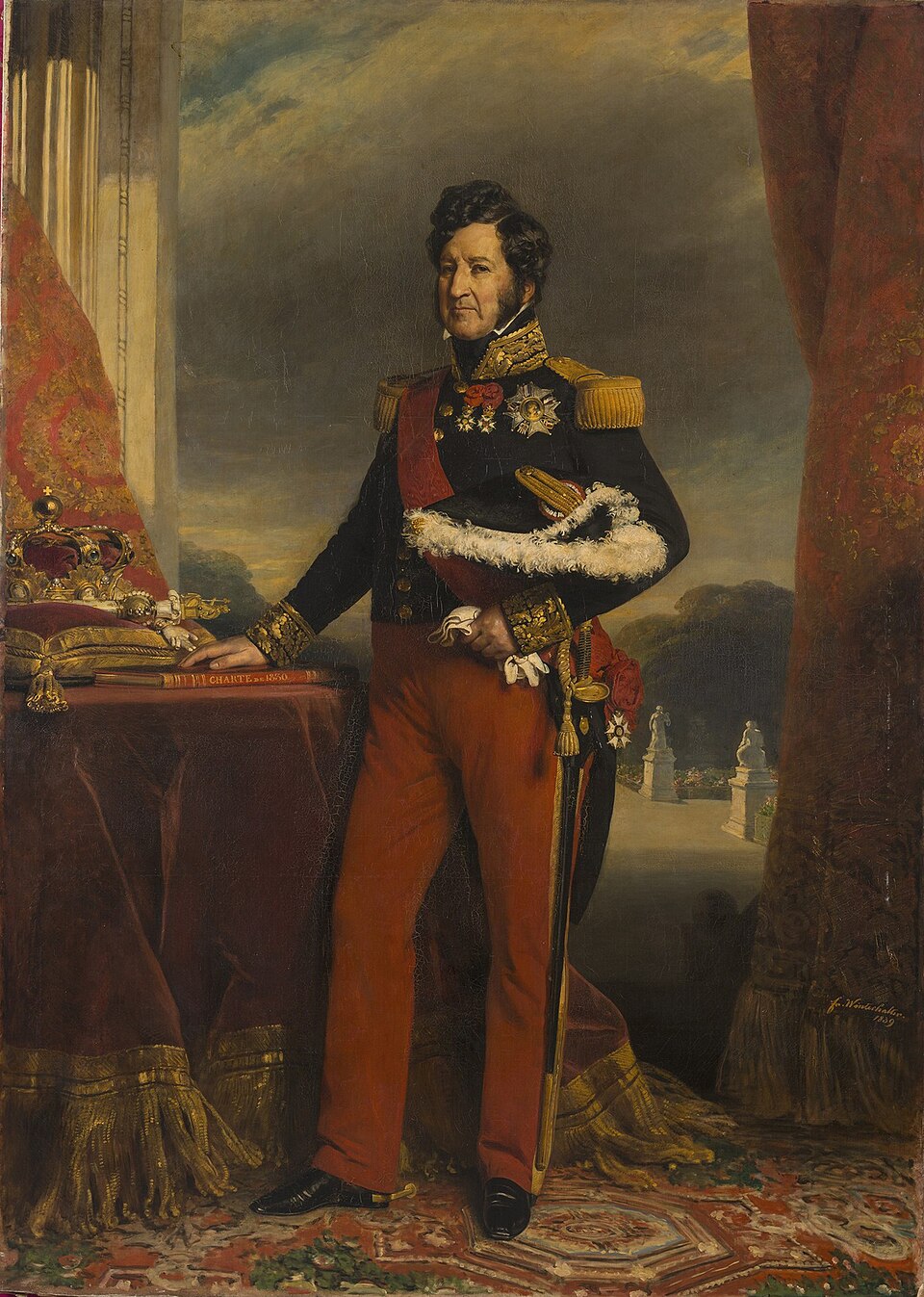

The painting also reveals the political undertones of the July Monarchy specifically through Louis-Philippe’s stance and uniform. Dressed in his National Guard (the reserve/militia forces of France) attire, subtly hinting at his meritocratic authority and military association, the depiction echoes the sentiment from Bonaparte’s Napoleonic code, a legal code adopted in 1804 to replace France’s previous patchwork of feudal laws with a single, consistent set of laws based on the idea of making the law more accessible and clearer for the common person. Napoleon cared deeply for his legal code, attending nearly half of the meetings where it was written by a council of lawyers personally assembled by Napoleon, as First Consul he even directed that one copy be made available for every citizen of France.44 In this painting, Louis-Philippe was dressed to garner support from the liberal masses by showcasing his military and leadership credentials, similar to Napoleon Crossing the Alps, that elevated the emperor’s military expertise. The regalia symbolises the monarchy’s institutional power highlighting how the king was not a divine ruler but the state’s chosen leader. This perception positions Louis-Philippe as a citizen deserving of being king through his military success and commitment to liberal values juxtaposing the traditional divine right of kings doctrine. This painting ultimately represents the king as an authority figure deserving of authority without absolute power.
The execution of this painting in the neoclassical style illustrated the political intentions of the Orléanist regime’s commitment to constitutional monarchy. By straying anyway from the newly popularized romantic style, Louis-Phillipe asserted that his reign was ushering in an era that worked to preserve and capitalize off of the greatness affiliated with the empire for the purpose of reigniting Napoleonic nationalism. Additionally, the painting works to showcase Louis-Philippe’s dedication to the role of constitutional monarch. Gérard’s conceptualization of the king sturdily positioned and stoically leaning on the Charter of 1830, presented how his authority stemmed from protecting the newly established constitutional framework of France. His pose indicates how Louis-Philipp was pledging to serve the French and lead in a manner that protects their rights enshrined in the charter. Unlike portraits of Napoleon where he was covered in jewels displaying him as the sovereign, Louis-Philippe leveraged the neoclassical style from Bonaparte to promote his own authority and appeal to the liberal public to secure support. Where Bonaparte built an imperial image to appeal to the masses of the 1789 revolution, Louis-Philippe built his image to appeal to the new liberalized French public and curated his vision through revitalizing Bonapartist nationalism and branding himself as a guardian of the revolutionary values of 1830.
This liberal shift is reflected by the provisions and rights codified in the Charter of 1830 which were formally recognized and protected by the king. The charter both enshrined rights for the French and established a governmental structure with Louis-Philippe at the helm, alongside a bicameral legislature that possessed the sole authority to pass laws. This is a stark contrast from the absolutism of previous regimes which prioritized centralized, unchecked authority. The charter exemplifies this liberal shift by declaring that, “Frenchmen are equal before the law, whatever otherwise may be their titles or their rank.”45 It went on to explicitly protect due process under the law by stating how, “Their individual liberty is equally guaranteed. No person can be either prosecuted or arrested, except in cases provided for by the law, and in the form which it prescribes.”46 The protection of civil liberties demonstrated how the Orléanist government preserved key elements of the Napoleonic Code—especially its commitment to legal equality–which decisively broke away from the arbitrary rule of the preceding Bourbon regime. This institutional and legal reform laid the groundwork for the revitalization of Napoleonic nationalism.
Throughout the 1830s, Louis-Philippe capitalized on the Napoleonic image by emphasizing French greatness through depictions of Napoleon and by elevating national history. This strategy aimed to unify public sentiment and establish his political legitimacy as a leader of the young regime, ultimately securing his legacy as the famed Citizen King. One of Louis-Philippe’s first major actions was continuing construction of the Arc de Triomphe l’Étoile after it was paused during the Bourbon Restoration. Completed in July of 1836, the figure embodied the empire, and Louis-Philippe finishing it is symbolic of his will to accentuate nationalism and growing support for the monarchy. This strategy drew on Bonaparte’s tactical use of artistic propaganda and relied on his liberal image as a way to demonstrate that the monarchy was upholding the revolutionary values that it had pledged to uphold. Alongside the completion of the architectural feat, Louis-Philippe worked to celebrate French history by imbuing it with nationalistic undertones for political gain.
As political tension mounted, the monarchy drew upon Napoleonic memory to win favor with the lower classes, who revered the emperor as a symbol of revolutionary ideals. In an effort to capitalize off this admiration, King Louis-Philippe orchestrated the return of Napoleon’s remains from Saint Helena to Paris–a gesture officially known as “Retour des cendres” or “Return of the Ashes.” Announced in December of 1840, the expedition to retrieve the emperor’s ashes from Saint Helena was a politically charged ploy to rally the lower classes and serves as further evidence of Philippe’s deliberate use of Bonaparte’s legacy for his own legitimacy. In his will, Bonaparte stated that, “It is my wish that my ashes may repose on the banks of the Seine, in the midst of the French people, whom I have loved so well.”47 Calls for Napoleon’s remains to be returned to France were rejected during the Bourbon Restoration, but the Orléanist regime used the opportunity–and the public’s enduring admiration for the emperor–to bolster nationalism and unite the nation around the idea of French greatness. The government’s intentionality is expressed in the memoir of François d’Orléans, son of Louis-Philippe and leader of the delegation that retrieved Bonaparte’s remains. The Prince explained that his father delegated the task to him and while he had reservations he wrote that, “I served my country and I had no right to discuss my orders.”48 He went on to celebrate Napoleon describing him as “the matchless warrior whose genius, even in defeat, had shed immortal glory on our arms…”49 François ultimately accepted his orders, recognizing how his role was a political gesture meant to stabilize the monarchy he believed to one day inherit. He later wrote, “To fetch his ashes from a foreign land was in a manner to wave the flag of vanquished France aloft once more—that at least was what we hoped for—and this view of the case reconciled me to my mission.”50
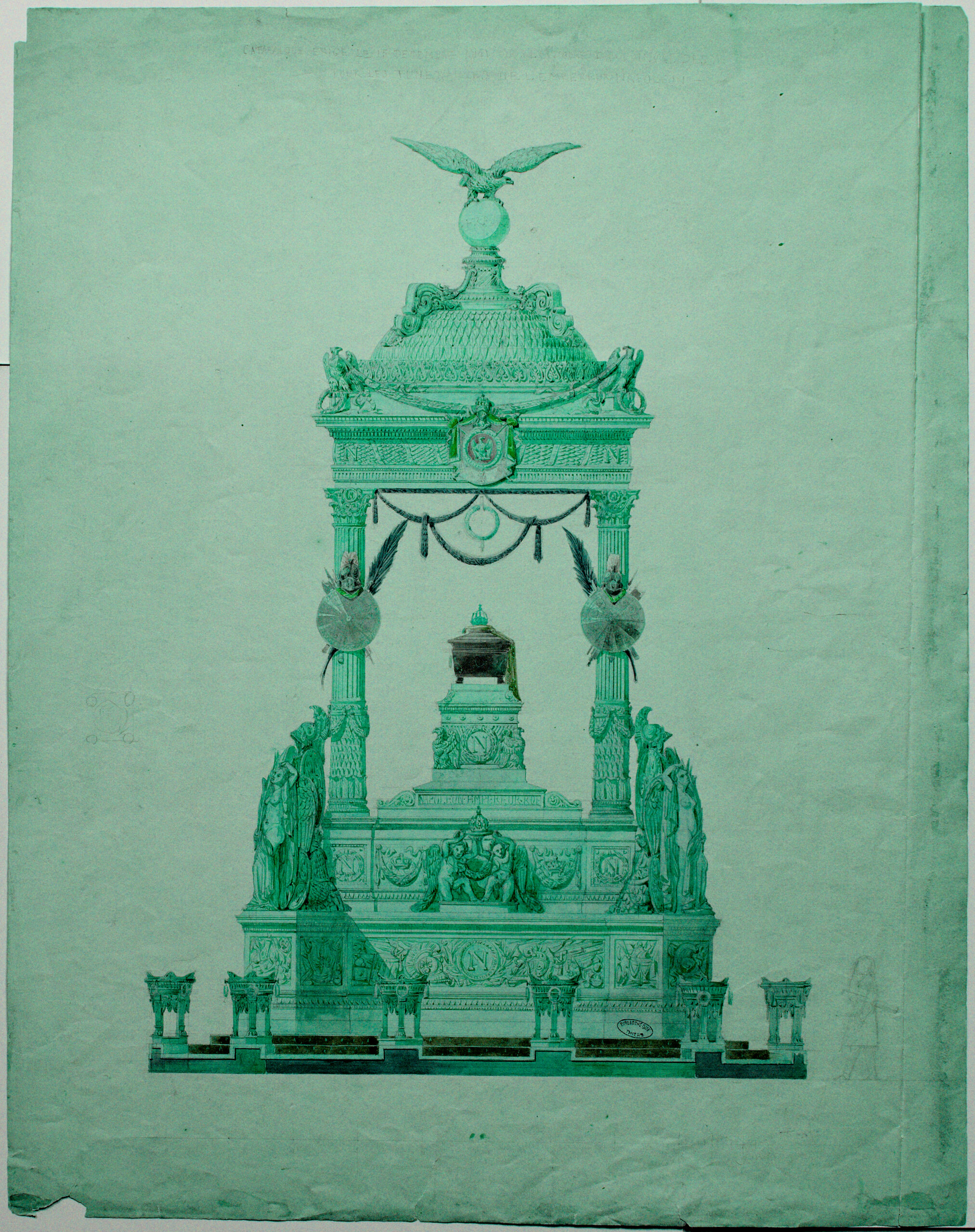
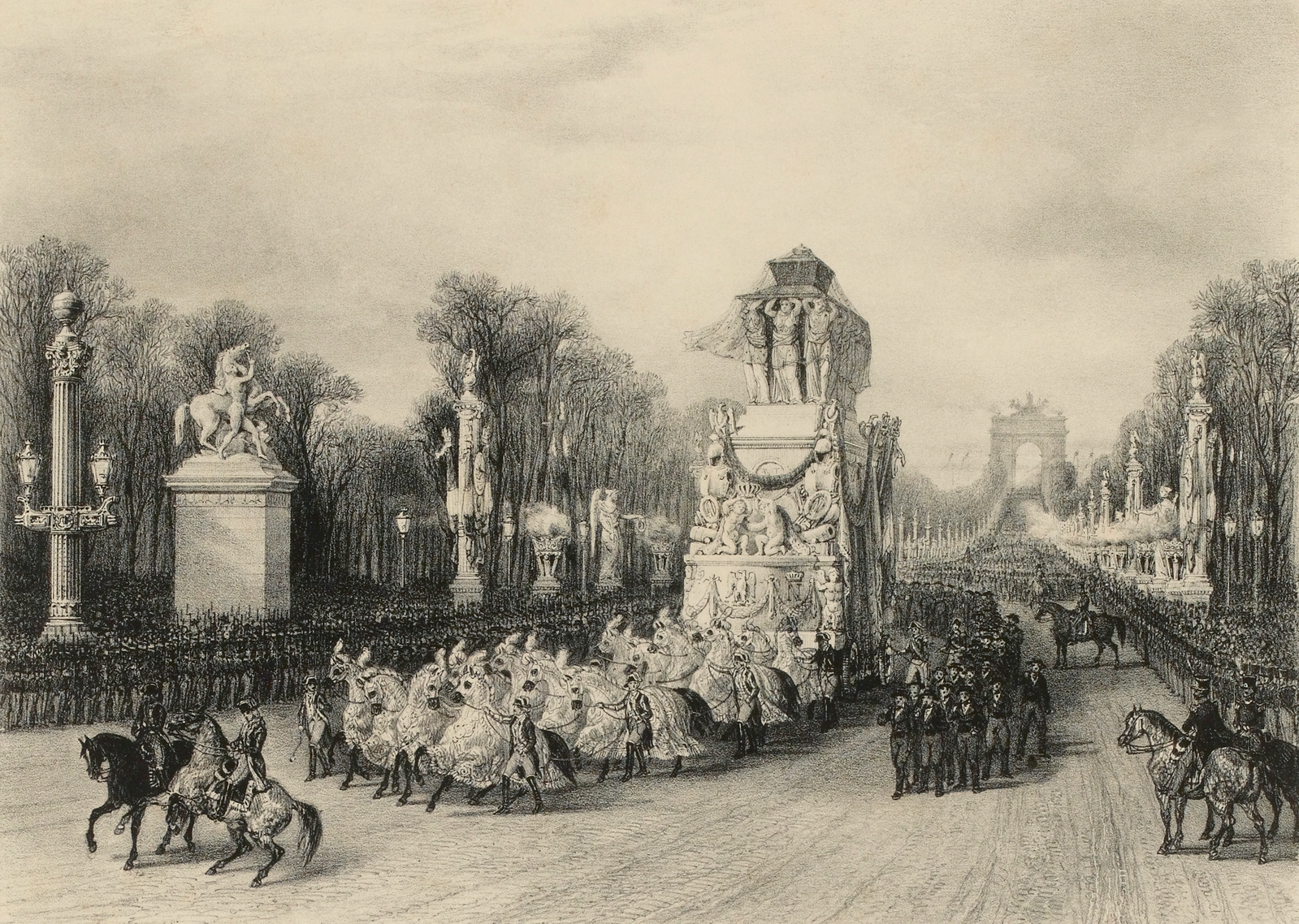
Upon the return of Napoleon’s ashes in May of 1840, Louis-Philippe began developing plans to lay the emperor in his final resting place in Paris. The French government chose architects Louis Visconti and Henri Labrouste to draw up plans for the celebratory return of the emperor by creating an elaborate and decorative casket for the emperor to be grieved and his legacy be celebrated (an image of their plans for the casket can be seen above this paragraph). Their design consisted of the coffin placed on a high pedestal carried by caryatids which was hauled on a funeral chariot and pulled by sixteen horses (a depiction of this coffin and its elaborate procession can be seen on the right and the right).51 While paraded through Paris, this architectural feat spotlighted the monarchy’s desperate grab for support by reminiscing on the greatness of the emperor. The architects also created large stands for the public allowing them to actively participate in mourning the emperor with their fellow Frenchmen (an image of this procession is under this paragraph). The casket would ultimately make its way to Les Invalides (also known as Hôtel des Invalides or House of the Invalids) where construction for his crypt included sculptures, columns, and bas-reliefs which honored depictions of Bonaparte’s life and military victories. While started under the July Monarchy, the project would not be complete until 1861, nearly twenty years after the collapse of the monarchy. The entire production of the Retour des cendres (return of the ashes) acted as theatrical political performance highlighting the dedication and lengths that the king was willing to go to advocate for his campaign. The citizen king image is based on the neoclassical liberalized appraisal from the emperor, but while Napoleon consolidated power by subjecting the nation under his imperial authority, Louis-Philippe’s liberal adaptation of Napoleonic liberalism was not strong enough to quench the thirst of the French People for democracy. Louis-Philippe’s reign ultimately came to an end with the Revolution of 1848 overthrowing the July Monarchy to give way to the birth of the Second Republic. The failure of Louis-Philippe’s political strategy revealed how the French were unsatisfied with constitutional monarchy and ready to usher in a new era where liberal values were on the forefront of the minds of government officials.
Conclusion: The Power of Visual Politics in Political Authority
While the Orléanist regime aimed to appeal to the lower classes, the rumblings from the Revolution of 1830 never subsided. The Revolution of 1848 signified France’s final push toward liberalism, resulting in the birth of the Second Republic after the Revolution of 1848. King Louis-Philippe’s use of visual politics and revival of the Neoclassical style to rally support for the monarchy, reveals both the role of visual culture in legitimizing political authority, and strength of nationalism in unifying the masses under a stable regime. Napoleon’s use of neoclassicism to craft an authoritarian and imperial style laid the foundation for a visual political strategy that merged heroism with state power. While Bonaparte’s approach emerged from the chaos following the chaos following the 1789 Revolution, Louis-Philippe’s adaptation reflected a more liberalized France in the 1830s. Though the July Monarchy’s liberal experiment ultimately failed, it revealed how political iconography could be repurposed to try to fabricate legitimacy. Where Napoleon elevated himself as a heroic symbol, Louis-Philippe reshaped that visual legacy to align with the romantic nationalism of his time–an effort to secure public support through memory, aesthetics, and myth.
As France moved into the later 1840s, Louis-Phillipe’s adaptation and reinvention of Napoleonic nationalism became increasingly apparent, particularly as the Orléanist regime raced a steady decline in power. The Return of the Ashes, served as a calculated political maneuver to rally public support. The imagery of both the Emperor and Citizen underscores the power of political iconography in early 19th century France, revealing how carefully crafted propaganda campaigns were used to shape public perception and secure authority.
Bibliography
Primary Sources
Charles X. The July Ordinances (25 July 1830). In The Constitutions and Other Select Documents Illustrative of the History of France, 1789–1907. 2nd ed., edited by Frank Maloy Anderson. New York: Russell and Russell, 1967. https://web.pdx.edu/~swalton/fr335U/july-ordinances.pdf.
Charter of 1830. In On Civil Liberty and Self-Government, 3rd rev. ed., edited by Theodore D. Woolsey. Philadelphia: J.B. Lippincott & Co., 1883. Translated and published online by Online Library of Liberty. Accessed April 17, 2025. https://oll.libertyfund.org/pages/1830-french-charter-of-1830.
d’Orléans, François-Ferdinand-Philippe-Louis-Marie, Prince de Joinville. Memoirs (Vieux Souvenirs) of the Prince de Joinville. Translated by Lady Mary Loyd. Project Gutenberg, May 1, 2004. eBook #5716. Accessed April 22, 2025. https://www.gutenberg.org/ebooks/5716.
Louis Philippe. Memoir of Louis Philippe I, King of the French. Oxford: Oxford University Press, 1830.
Napoleon I. Last Will and Testament. Translated and published by Napoleon.org. January 2007. Accessed April 22, 2025. https://www.napoleon.org/en/history-of-the-two-empires/articles/napoleons-last-will-and testament/.
Thiers, Adolphe. Orleanist Manifesto (30 July 1830). In The Constitutions and Other Select Documents Illustrative of the History of France, 1789–1907, 2nd ed., edited by Frank Maloy Anderson. New York: Russell and Russell, 1967. https://web.pdx.edu/~swalton/fr335U/july-ordinances.pdf.
Secondary Sources
Boime, Albert. A Social History of Modern Art. Vol. 2, Art in an Age of Bonapartism, 1800-1815. Chicago: University of Chicago Press, 1990.
Day-Hickman, Barbara Ann. Napoleonic Art: Nationalism and the Spirit of Rebellion in France (1815–1848). Illustrated ed. Newark: University of Delaware Press, 1999. https://books.google.com/books/about/Napoleonic_Art.html?id=m5f4wBjW9s0C.
Hazareesingh, Sudhir. “Napoleonic Memory in Nineteenth-Century France: The Making of a Liberal Legend.” MLN 120, no. 4 (2005): 747–73. http://www.jstor.org/stable/3840656.
Kohn, Hans. “The Idea of Nationalism: Napoleon and the Age of Nationalism.” The Journal of Modern History 22, no. 1 (1950): 21–37. http://www.jstor.org/stable/1875877.
Mellon, Stanley. “The July Monarchy and the Napoleonic Myth.” Yale French Studies, no. 26 (1960): 70–78. https://doi.org/10.2307/2929226.
Munhall, Edgar. “Portraits of Napoleon.” Yale French Studies, no. 26 (1960): 3–20. https://doi.org/10.2307/2929218.
Rowell, Diana. Paris: The “New Rome” of Napoleon I. London: Continuum, 2012. https://openurl.ebsco.com/c/icphr5/EPDB%3Ae000xna%3A6%3A2171158/detailv2?sid=ebsco%3Aplink&id=ebsco%3Ae000xna%3A494700&crl=f&prompt=none&x-cgp-token=icphr5&link_origin=none.
Wallace-Hadrill, Andrew. “Roman Arches and Greek Honours: The Language of Power at Rome.” Proceedings of the Cambridge Philological Society, no. 36 (216) (1990): 143–81. http://www.jstor.org/stable/44696685.
Footnotes
- Edgar Munhall, “Portraits of Napoleon,” Yale French Studies, no. 26 (1960): 3–20, https://doi.org/10.2307/2929218. ↩︎
- Munhall, “Portraits of Napoleon,” 3. ↩︎
- Albert Boime, Art in the Age of Bonapartism:A Social History of Modern Art, Volume 2, 1800-1815. (Chicago: University of Chicago Press, 1990). ↩︎
- Boime, Art in the Age, 202. ↩︎
- Boime, Art in the Age, 13. ↩︎
- Diana Rowell, Paris: The ‘New Rome’ of Napoleon I (London: Continuum, 2012) 1, EBSCOhost. ↩︎
- Rowell, Paris, 16. ↩︎
- Stanley Mellon, “The July Monarchy and the Napoleonic Myth,”Yale French Studies, no. 26 (1960): 72, https://doi.org/10.2307/2929226. ↩︎
- Mellon, “The July Monarchy,” 73. ↩︎
- Mellon, “The July Monarchy,” 72. ↩︎
- Hans Kohn, “Napoleon and the Age of Nationalism,” The Journal of Modern History 22, no. 1 (1950): 22, https://www.jstor.org/stable/1875877. ↩︎
- Kohn, “Napoleon,” 22. ↩︎
- Sudhir Hazareesingh,“Napoleonic Memory in Nineteenth-Century France: The Making of a Liberal Legend,” MLN 120, no. 4 (2005): 753. https://www.jstor.org/stable/3840656. ↩︎
- Hazareesingh,“Napoleonic Memory,” 762. ↩︎
- Hazareesingh,“Napoleonic Memory,” 762. ↩︎
- Jacques-Louis David, Death of Marat, 1793, oil on canvas, Royal Museums of Fine Arts of Belgium, Brussels, https://fine-arts-museum.be/en/exhibitions/the-death-of-marat. ↩︎
- Jacques-Louis David, Napoleon Crossing the Saint-Bernard in David, Jacques-Louis. “Napoleon Crossing the Alps, Belvedere Version.” World History Encyclopedia. Last modified June 02, 2023. https://www.worldhistory.org/image/17490/napoleon-crossing-the-alps-belvedere-version/. ↩︎
- Equestrian Statuette of Charlemagne. 9th century. Bronze. Museo Omero, Ancona. Accessed April 29, 2025, https://museoomero.it/en/opere/equestrian-statuette-of-charlemagne/. ↩︎
- Boime, Art in the Age, 40. ↩︎
- Jacques-Louis David, “The Coronation of Napoleon I,” World History Encyclopedia, Last modified July 03, 2023, https://www.worldhistory.org/image/17560/the-coronation-of-napoleon-i/. ↩︎
- Boime, Art in the Age, 201. ↩︎
- Boime, Art in the Age, 201. ↩︎
- Jacques-Louis David, Account of the celebrated picture of the Coronation of Napoleon, 1821 in David, ed, Simon Lee (London: Phaidon Press Limited, 1999), 258. ↩︎
- Andrew Wallace-Hadrill, “Roman Arches and Greek Honours: The Language of Power at Rome,” Proceedings of the Cambridge Philological Society, no. 36 (216) (1990): 147, http://www.jstor.org/stable/44696685. ↩︎
- Rowell, Paris: The, 38-39. ↩︎
- The Miriam and Ira D. Wallach Division of Art, Prints and Photographs: Photography Collection, The New York Public Library. “Arc de Triomphe du Carrousel” New York Public Library Digital Collections. Accessed March 21, 2025. https://digitalcollections.nypl.org/items/510d47e3-c040-a3d9-e040-e00a18064a99. ↩︎
- Rowell, Paris: The, 48. ↩︎
- Rowell, Paris: The, 48. ↩︎
- L’Arc-de-Triomphe de l’Étoile, Paris, France, photograph, between 1890 and 1900, Library of Congress, https://www.loc.gov/item/92518891/. ↩︎
- Boime, Art in the Age, 13-14. ↩︎
- Rowell, Paris: The, 38. ↩︎
- Hazareesingh,“Napoleonic Memory,” 757. ↩︎
- Hazareesingh,“Napoleonic Memory,” 757. ↩︎
- Hazareesingh,“Napoleonic Memory,” 770. ↩︎
- Barbara Ann Day-Hickman, Napoleonic Art: Nationalism and the Spirit of Rebellion in France (1815–1848), illustrated ed. (Newark: University of Delaware Press, 1999), 18, https://www.google.com/books/edition/Napoleonic_Art/m5f4wBjW9s0C?hl=en. ↩︎
- Charles X, The July Ordinances (25 July 1830), in The Constitutions and Other Select Documents Illustrative of the History of France, 1789–1907, 2nd ed., ed. Frank Maloy Anderson (New York: Russell and Russell, 1967), https://web.pdx.edu/~swalton/fr335U/july-ordinances.pdf. ↩︎
- Eugène Delacroix. Liberty Leading the People, 1830. Oil on canvas. Musée du Louvre, Paris, https://commons.wikimedia.org/wiki/File:La_Libert%C3%A9_guidant_le_peuple_-_Eug%C3%A8ne_Delacroix_-_Mus%C3%A9e_du_Louvre_Peintures_RF_129_-_apr%C3%A8s_restauration_2024.jpg. ↩︎
- Adolphe Thiers, Orleanist Manifesto (30 July 1830), in The Constitutions and Other Select Documents Illustrative of the History of France, 1789–1907, 2nd ed., ed. Frank Maloy Anderson (New York: Russell and Russell, 1967), https://web.pdx.edu/~swalton/fr335U/july-ordinances.pdf. ↩︎
- Louis Philippe, “Memoir of Louis Philippe i., king of the French” (Oxford: Oxford University, 1830), 28, https://www.google.com/books/edition/Memoir_of_Louis_Philippe_i_king_of_the_F/_WQIAAAAQAAJ?hl=en&gbpv=1&pg=PA1&printsec=frontcover#v=onepage&q&f=fal%20se. ↩︎
- Louis Philippe, Memoir of Louis Philippe I., 28. ↩︎
- Louis Philippe, Memoir of Louis Philippe I., 29. ↩︎
- Sarah Hanley, “Configuring the Authority of Queens in the French Monarchy, 1600s-1840s,” Historical Reflections / Réflexions Historiques 32, no. 2 (2006): 461, https://www.jstor.org/stable/41299380. ↩︎
- François Gérard, Portrait de Louis Philippe I, 1834. Oil on canvas. Palace de Versailles, Versailles, https://commons.wikimedia.org/wiki/File:Franz_Xaver_Winterhalter_King_Louis_Philippe.jpg. ↩︎
- Steven Englund, Napoleon: A Political Life (Cambridge: Harvard University Press, 2004), 189-190. ↩︎
- Charter of 1830, in On Civil Liberty and Self-Government, 3rd rev. ed., ed. Theodore D. Woolsey (Philadelphia: J.B. Lippincott & Co., 1883), trans. and published online by Online Library of Liberty, accessed April 17, 2025, https://oll.libertyfund.org/pages/1830-french-charter-of-1830. ↩︎
- Charter of 1830, in On Civil Liberty and Self-Government, ed. Theodore D. Woolsey, trans. Online Library of Liberty. ↩︎
- Napoleon I, Last Will and Testament, trans. and pub. Napoleon.org, January 2007, accessed April 22, 2025, https://www.napoleon.org/en/history-of-the-two-empires/articles/napoleons-last-will-and-testament/. ↩︎
- Napoleon I, Last Will… ↩︎
- Napoleon I, Last Will… ↩︎
- François-Ferdinand-Philippe-Louis-Marie d’Orléans, Prince de Joinville, Memoirs (Vieux Souvenirs) of the Prince de Joinville, trans. Lady Mary Loyd (Project Gutenberg, May 1, 2004), eBook #5716, accessed April 22, 2025, https://www.gutenberg.org/ebooks/5716. ↩︎
- Henri Labrouste and Louis Visconti, Architectural Design, 1840, black stone, pen, and black ink on paper, 56.7 × 44.7 cm, Thiers Library, Masson Collection, DM 203, Photo Fondation Napoléon – François Houdecek, accessed April 22, 2025, https://www.napoleonica.org/fr/collections/architecture/DM_203?context=collection¤t=39&page=1&pageSiz%20e=20&total=84; Paul Joseph Dumouza and Pierre Frédéric Lehnert, Funérailles de l’Empereur Napoléon / Passage du char funèbre aux Champs-Elysées / le 15 Dcécembre 1840, ca. 1840, Lithographie, Musée Carnavalet, Paris, France, https://www.parismuseescollections.paris.fr/fr/musee-carnavalet/oeuvres/funerailles-de-l-empereur-napoleon-passage-du-char-funebre-aux-champs#infos-principales. ↩︎